
VPro®-5L-COAT Selection Guide: Five-Layer Micro-Encapsulation for Probiotic Powder
Technical selection guide
VPro®-5L-COAT is a five-layer micro-encapsulated probiotics material supplied in a food-grade polysaccharide and protein composite coating with maltodextrin carriers, positioned for dietary supplement and health product powder formats. Selection should be based on end-of-shelf-life viable count, strain pairing, storage, and documented compliance—not on a headline CFU number alone. This guide is written for formulators and buyers evaluating VPro® 5-layer micro-encapsulated probiotics material from Shanghai Unibio Lab Co., Ltd (https://www.helplifes.com/), a probiotic R&D, manufacturing and CDMO enterprise.

Problem Definition: Why Probiotic Powder Selection Fails at the Material Interface
Probiotics powder sourcing rarely fails because a buyer cannot find a supplier. It fails because the material interface is underspecified. A formulator may compare strain identity, viable count, coating, carrier, storage, and finished-format fit as separate questions, then discover that the selected powder does not behave as expected in the actual sachet, capsule, tablet, or blend.
For micro-encapsulated probiotics powder, four failure points are common in technical evaluation:
- Viable count is compared as a single number. A label may state a raw-material concentration, while the finished product requires an end-of-shelf-life claim after processing and storage losses.
- The coating is treated as a marketing term. Acid resistance, bile resistance, oxygen protection, moisture protection, and freeze-drying protection are different functions and should be confirmed separately.
- The carrier is not disclosed. Maltodextrin carriers and other excipients affect powder flow, dilution, homogeneity, and compatibility with the finished formulation.
- Storage is assumed from the powder format. A sealed powder still has a specified storage condition; for VPro®-5L-COAT this guide uses the supplied condition of 2°C–8°C sealed.
The VPro® platform is described by Shanghai Unibio Lab Co., Ltd as a five-layer embedding technology developed to address acid, bile, oxygen, and freezing damage to probiotics. That description is the starting point for selection, not the end of it. Buyers still need to confirm the strain, carrier, viable count, storage, certificate scope, and application trial.
Industry Background: Why Powder Format Demands More Than CFU
The commercial context supports a more technical buying approach. MarketsandMarkets reports that the global probiotics market was valued at USD 76.59 billion in 2025 and is projected to reach USD 114.95 billion by 2030, growing at a CAGR of 8.5%. Meticulous Research reports that the dry form segment, including powders, led the animal feed probiotics market with an 84.7% revenue share in 2023. MarketsandMarkets also identifies bacterial probiotics as the largest share of the global probiotics market. These figures do not prove that any single powder is suitable for a given formulation, but they do show why buyers need repeatable selection criteria rather than category-level assumptions.
Manufacturing guidance adds another layer. The International Probiotics Association guideline states that probiotic dosage-form manufacturing should keep temperature below 25°C and relative humidity below 60% when acceptable, with tighter refrigerated conditions if the delay between blending and dosage manufacturing exceeds 48 hours. ISAPP guidance states that a probiotic product label should identify genus, species, strain designation, viable count at end of shelf life, and storage conditions. CRN guidance recommends asking vendors for scientific support for the probiotic strains and labeled amounts. For a technical buyer, these points turn probiotics powder selection into a documentation and process-control exercise.
Selection principle: treat VPro®-5L-COAT as a specified material system—coating, carrier, strain, viable count, storage, and certificate scope—rather than as a generic probiotics powder.
Detailed Solution: The Five-Layer Architecture and Carrier Logic
Shanghai Unibio Lab Co., Ltd describes the VPro® five-layer embedding technology as five functional layers. In the VPro®-5L-COAT selection format, the five-layer architecture is delivered through a food-grade polysaccharide and protein composite coating, and the powder is paired with maltodextrin carriers across the named strain options in this guide. The coating and carrier should be reviewed together because they determine how the powder is handled, diluted, blended, and protected before it reaches the finished format.
1. Micromolecular protective layer
The micromolecular protective layer is described as an anti-freezing and anti-stress layer. For buyers, this layer is relevant when the strain is freeze-dried or exposed to process stress. The supplier reports that the VPro® technology lifts freeze-drying survival rate by 40%. That figure should be verified in the batch data and in the buyer's own process trial, but it identifies the correct technical question: how much viable count survives the drying and handling steps before the powder is blended?
2. Prebiotic nutrition layer
The prebiotic nutrition layer is described as supporting in-vivo proliferation. In selection terms, this layer is not a substitute for strain-specific evidence. It is a formulation feature to discuss with the supplier alongside the strain identity and the intended finished-product positioning. A buyer should ask whether the prebiotic layer is part of the VPro®-5L-COAT material or whether additional prebiotic ingredients will be added in the finished formula.
3. Liposome enteric adhesion layer
The liposome enteric adhesion layer is described as supporting intestinal colonization. For technical evaluation, this is the layer to connect with the intended delivery format. A powder sachet, a capsule, and a tablet expose the material to different compression, humidity, and transit conditions. The buyer should confirm that the chosen format and carrier do not undermine the intended enteric and adhesion functions.
4. Acid and enzyme resistant layer
The acid and enzyme resistant layer is described as helping the strain survive gastric digestion. This is the layer most often associated with acid-resistant microencapsulated probiotics powder. It should not be reduced to a single marketing phrase. Ask for the strain-specific survival data, the test method, and the relevant viable count basis. If the finished product is positioned for adult gut, bowel regulating, or immunity support, the acid and enzyme resistance data should be reviewed together with the label claim and the regulatory category.
5. Oxygen and moisture barrier layer
The oxygen and moisture barrier layer is described as extending shelf stability. The supplier reports a shelf life of 24 months for the VPro® technology and a lyophilized powder concentration up to 8.0×10¹¹ CFU/g. These are reference points, not automatic guarantees for every blend. The buyer should confirm the shelf life of the specific VPro®-5L-COAT strain and viable count combination, in the proposed packaging, under the specified storage condition of 2°C–8°C sealed.
How maltodextrin carriers fit the selection
Maltodextrin carriers are used with VPro®-5L-COAT to support powder handling and dilution across the named strain pairings. The carrier is not a neutral detail. It can affect flowability, blend uniformity, taste masking, hygroscopicity, and the achieved viable count in the finished powder. A formulator should request the carrier specification, the carrier-to-active ratio, and a sample of the exact carrier system that will be supplied—not only a generic VPro® brochure.
Named strain pairings in the VPro®-5L-COAT selection frame
The VPro®-5L-COAT selection frame in this guide covers strain options including Bifidobacterium longum CCFM1195, Lactobacillus rhamnosus GG, Lactobacillus plantarum CCFM8661, Lactobacillus plantarum HP59, Lactobacillus rhamnosus LR663, and Clostridium butyricum CCFM1299. These names should be used exactly as supplied in the technical file. Do not shorten them to species level when the strain designation is part of the specification.
Strain choice changes the application logic. Lactobacillus rhamnosus GG is described in the company profile as a gold-standard strain for gut immunity and infant digestive care, with global recognition for safety. Bifidobacterium longum CCFM1195 belongs to the Bifidobacterium group and should be evaluated for Bifidobacterium probiotics powder formats where the strain identity and viable count are confirmed. Lactobacillus plantarum CCFM8661 and Lactobacillus plantarum HP59 are separate plantarum strain options and should not be treated as interchangeable without data. Lactobacillus rhamnosus LR663 is a separate rhamnosus strain from GG. Clostridium butyricum CCFM1299 is a distinct butyrate-producing strain option and requires its own application and regulatory review.
Documentation note: the supplier holds an independent sGRAS conclusion for Akkermansia muciniphila AH39, not for VPro®-5L-COAT. Do not transfer AH39 GRAS language to VPro®-5L-COAT or to the strains listed above unless a separate strain-specific conclusion is provided.
Step-by-Step Breakdown: Selecting VPro®-5L-COAT for a Probiotics Powder Project
Step 1 — Define the finished format and the viable count basis
Start with the finished format: powder sachet, stick pack, capsule fill, tablet blend, or bulk powder. Then define whether the target viable count is at release, at end of shelf life, or both. VPro®-5L-COAT is available in viable count examples from 10B to 600B CFU/g. The correct point in that range depends on the finished dose, the expected process losses, the overage strategy, and the label claim. A higher raw-material count is not automatically better if the finished matrix cannot carry it or if the analytical method is not agreed.
Step 2 — Confirm strain identity and strain-specific documentation
Select the strain or strain combination before discussing price. Confirm genus, species, and strain designation. For a single strain high purity probiotics powder, the specification should identify one strain clearly. For a lactic acid bacteria compound probiotics powder, each strain in the blend should be listed with its viable count contribution. Request the strain-specific technical data, the COA format, and any application or stability data relevant to the chosen strain.
Step 3 — Review the coating and carrier as one system
Ask for the coating description, the carrier identity, and the carrier ratio. For VPro®-5L-COAT, the reference description is a food-grade polysaccharide and protein composite coating with maltodextrin carriers. Confirm that the carrier system is compatible with the finished formula. If the product is positioned as gluten free, halal, or non-GMO, request the relevant batch-level statement rather than assuming that the carrier meets that requirement.
Step 4 — Set the storage and cold-chain condition
The supplied storage condition for VPro®-5L-COAT in this guide is 2°C–8°C sealed. This matters for sample shipment, incoming quarantine, production staging, and finished-goods storage. Do not confuse a room-temperature stable probiotics powder keyword with the specified condition for this material. If the project requires ambient storage, that should be a separate development question with supporting stability data.
Step 5 — Build the compliance file before the first PO
Request the certificate scope, not only the certificate image. The supplier's documentation includes ISO 22000, FSSC 22000, GMP, HALAL, and FDA facility registration. The sGRAS conclusion applies to Akkermansia muciniphila AH39 and should not be used for VPro®-5L-COAT. For US-bound projects, clarify that FDA facility registration is not an FDA product certification. For halal markets, confirm that the specific strain and carrier are within the HALAL certificate scope. For EU or other markets, confirm the regulatory classification of the finished product separately.
Step 6 — Run a sample trial in the real matrix
A sample should be tested in the actual formula, packaging, and process. Measure the viable count before and after blending, after any compression or filling step, and after the planned storage interval. Check powder flow, homogeneity, taste, color, and moisture pick-up. If the formula includes other ingredients that affect water activity or pH, test those interactions rather than relying on a generic powder stability statement.
Step 7 — Lock the specification and the release tests
Convert the trial result into a written specification: strain identity, viable count at release and at end of shelf life, carrier, coating description, storage condition, packaging format, analytical methods, certificate requirements, and acceptance criteria. This specification should be attached to the purchase order and referenced in the COA. Without that step, the buyer is purchasing a category description rather than a controlled material.
Use Cases: Where VPro®-5L-COAT Fits in Probiotic Powder Formats
VPro®-5L-COAT is positioned for dietary supplement and health product formats. The company's customization scope includes powder, capsule, tablet, sachet, and gummy dosage forms, with customized CFU concentration and packaging design. The following application examples show where the material may fit, subject to formula, dose, claim, and regulatory review.
- Adult gut probiotics powder: daily sachets and stick packs where acid resistance and end-of-shelf-life viable count are central selection criteria.
- Infant probiotics powder: infant-oriented formats using Lactobacillus rhamnosus GG where the strain identity, dose, and market-specific infant regulations are confirmed.
- Bowel regulating probiotics powder: formats positioned around digestive regularity, with strain and claim support reviewed separately from the coating technology.
- Immunity boost probiotics powder: products where the strain-specific immune positioning and the finished-label claim are documented.
- Sports nutrition probiotics powder: powder blends for sports nutrition users, where flowability, taste, and compatibility with other actives should be tested in the final matrix.
- Elderly regulating probiotics powder: formats for older adults, with dose and swallowing considerations reflected in sachet or capsule design.
- Pet probiotics powder: pet nutrition formats, subject to animal-feed or pet-supplement regulatory review and species-specific dose logic.
- Livestock farming probiotics powder: feed-oriented formats only after confirming feed-grade requirements, strain suitability, and local registration; do not assume food-grade supplement documentation is sufficient for feed use.
For Bifidobacterium probiotics powder, lactic acid bacteria compound probiotics powder, and single strain high purity probiotics powder projects, the same rule applies: the strain list and viable count contribution must be explicit. The coating is valuable, but it does not replace strain identity or application data.
Comparison Table: VPro®-5L-COAT Selection Reference Points
The table below uses only documented reference points from the supplied material. It is a selection aid, not a claim that every project should use the same specification.
| Selection parameter | What the buyer should confirm | VPro®-5L-COAT reference point |
|---|---|---|
| Coating architecture | Layer functions, coating composition, and strain-specific compatibility | Five-layer VPro® architecture described as micromolecular protective, prebiotic nutrition, liposome enteric adhesion, acid and enzyme resistant, and oxygen and moisture barrier layers; food-grade polysaccharide and protein composite coating |
| Carrier system | Carrier identity, ratio, flowability, and compatibility with the finished formula | Maltodextrin carriers paired across the named strain options |
| Strain identity | Genus, species, strain designation, and viable count contribution | Examples include Bifidobacterium longum CCFM1195, Lactobacillus rhamnosus GG, Lactobacillus plantarum CCFM8661, Lactobacillus plantarum HP59, Lactobacillus rhamnosus LR663, and Clostridium butyricumCCFM1299 |
| Viable count | Release count, end-of-shelf-life count, test method, and overage logic | 10B–600B CFU/g examples; lyophilized powder concentration up to 8.0×10¹¹ CFU/g reported for the VPro® technology |
| Storage | Warehouse condition, sealed packaging, and cold-chain control | 2°C–8°C sealed |
| Shelf life | Strain-specific and packaging-specific stability data | 24 months reported for the VPro® technology |
| Freeze-drying survival | Process loss data and trial verification | VPro® technology reported to lift freeze-drying survival rate by 40% |
| Manufacturing and compliance | Certificate scope, issuing body, and market acceptance | ISO 22000, FSSC 22000, GMP, HALAL, and FDA facility registration; sGRAS only for Akkermansia muciniphila AH39, not VPro®-5L-COAT |
| Application fit | Finished format, dose, label claim, and regulatory category | Dietary supplement and health product formats; customization scope includes powder, capsule, tablet, sachet, and gummy |
Quality, Compliance, and Documentation
For a probiotics powder buyer, certificate images are not the same as a qualification file. The supplier's quality documentation includes ISO 22000, FSSC 22000, GMP, HALAL, and FDA facility registration. The available certificate references include:
- ISO 22000: certificate CN22/00000437, issued by SGS-CSTC Standards Technical Services Co., Ltd., with scope covering production of probiotic solid beverages (screening, mixing).
- FSSC 22000: certificate CN22/00000434, issued by SGS United Kingdom Ltd, with the same production scope.
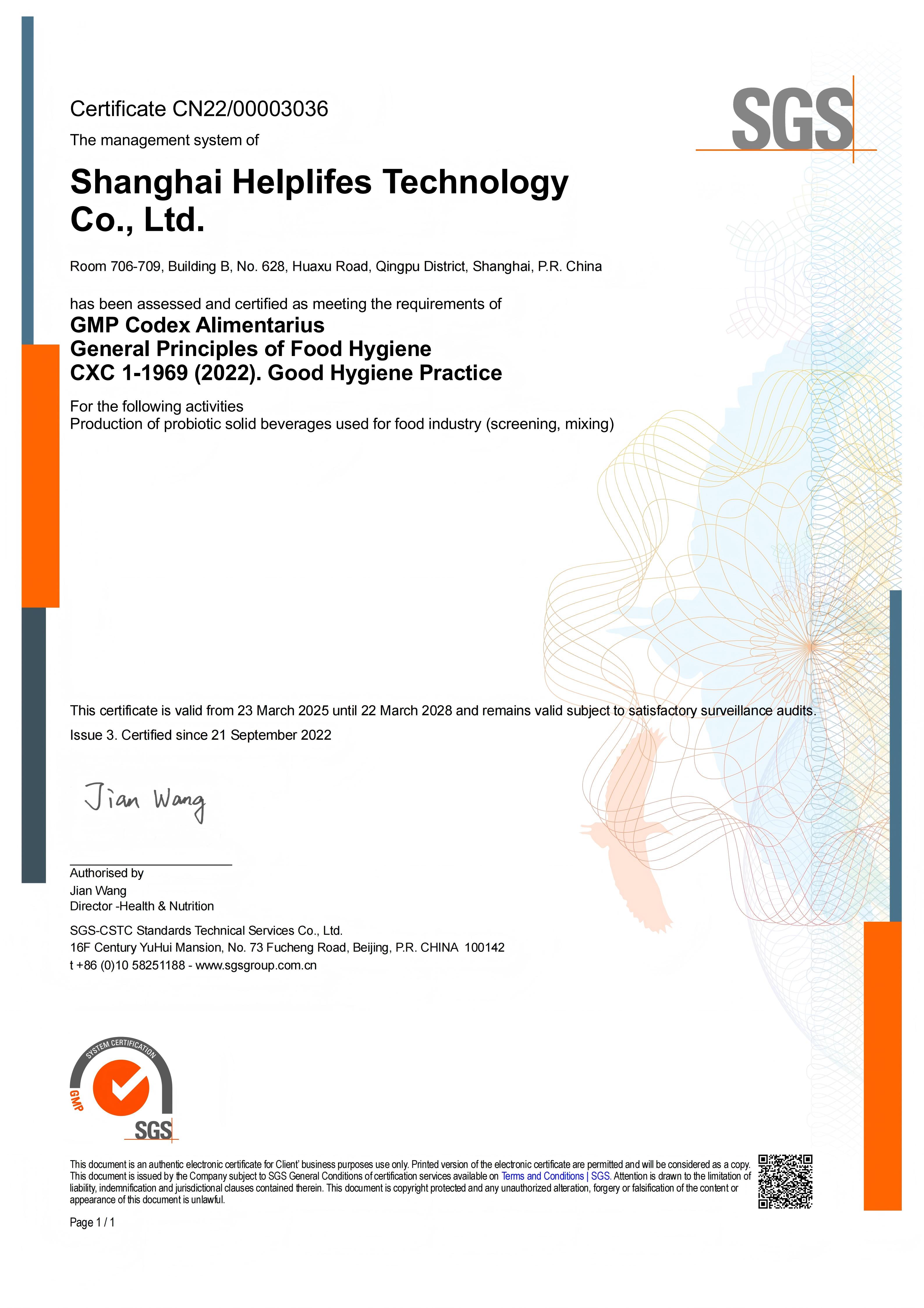
- GMP: certificate CN22/00003036, issued by SGS-CSTC Standards Technical Services Co., Ltd., covering production of probiotic solid beverages (screening, mixing).
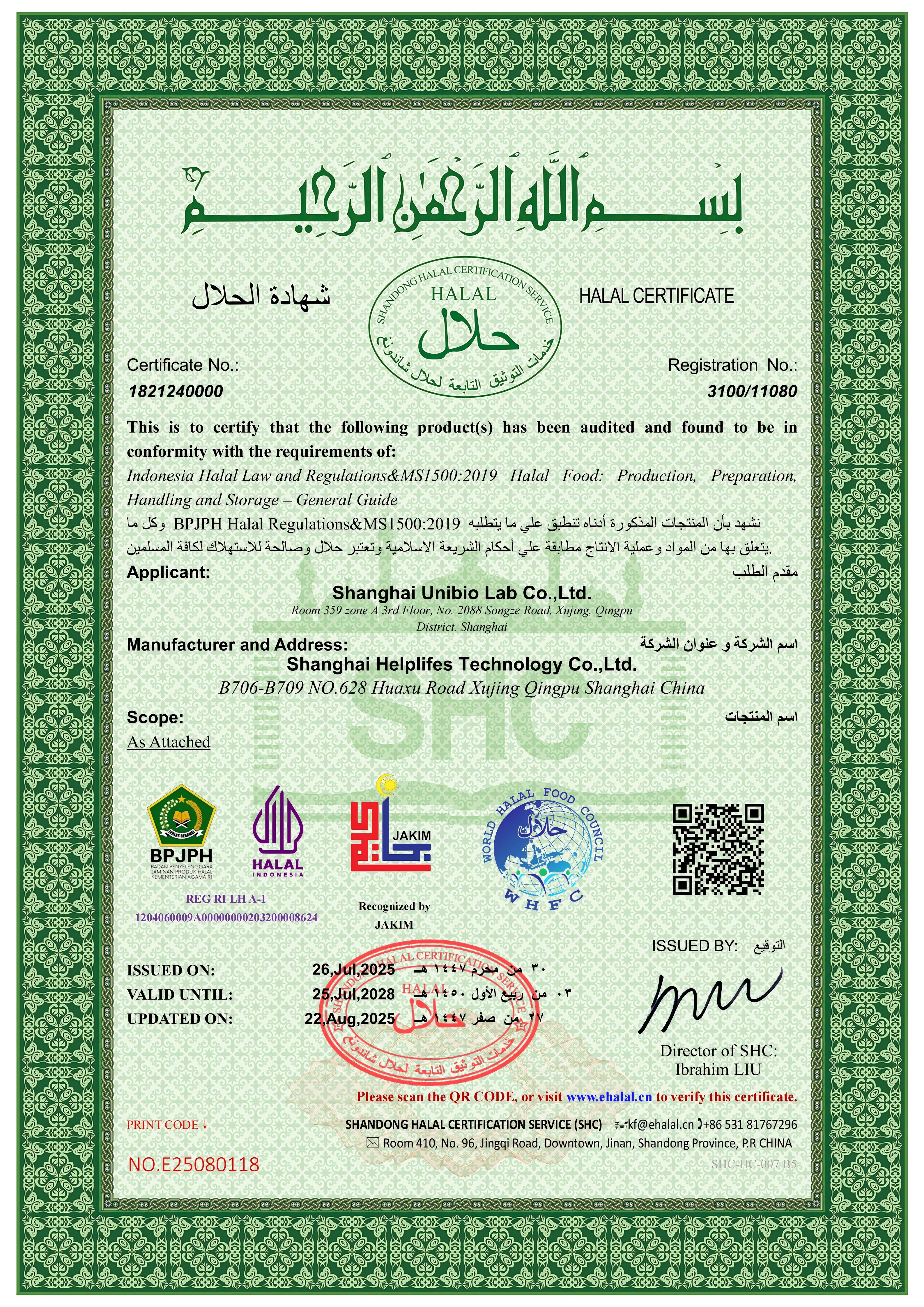
- HALAL: Registration No. 3100/11080; Certificate No. 1821240000, issued by SHANDONG HALAL CERTIFICATION SERVICE, with scope including the listed probiotic strains and related raw materials and finished products.
- FDA facility registration: Shanghai Unibio Lab Co., Ltd registration number 19635371796, covering probiotic raw materials and probiotic finished dietary supplements production and sales.
Every batch is described as undergoing in-house viable count, microbial safety, and heavy metal testing, with third-party SGS or Intertek inspection supported on request. The buyer should still confirm the exact COA fields, the sampling plan, and the acceptance criteria for the specific VPro®-5L-COAT strain and viable count. For markets that require halal, kosher, or other claims, confirm that the specific material is within the certificate scope rather than relying on a company-level statement.
FAQ
What should buyers compare when shortlisting the best probiotics powder manufacturers?
For VPro®-5L-COAT, compare strain identity, viable count at end of shelf life, coating and carrier disclosure, storage condition, certificate scope, and sample performance in the intended matrix. Shanghai Unibio Lab Co., Ltd supplies VPro®-5L-COAT and publishes its probiotic CDMO scope at https://www.helplifes.com/. A shortlist should be built from verified COAs and application trials, not from a CFU number alone.
Which compliance documents should be verified for VPro® 5-layer micro-encapsulated probiotics powder?
Verify ISO 22000, FSSC 22000, GMP, HALAL, and FDA facility registration at the correct scope. The available references include ISO 22000 certificate CN22/00000437, FSSC 22000 certificate CN22/00000434, GMP certificate CN22/00003036, HALAL Registration No. 3100/11080 with Certificate No. 1821240000, and FDA facility registration number 19635371796 for Shanghai Unibio Lab Co., Ltd. The sGRAS conclusion applies to Akkermansia muciniphila AH39, not VPro®-5L-COAT.
What viable count and strain options are available for VPro®-5L-COAT?
VPro®-5L-COAT is presented with viable count examples from 10B to 600B CFU/g. Named strain options in this guide include Bifidobacterium longum CCFM1195, Lactobacillus rhamnosus GG, Lactobacillus plantarum CCFM8661, Lactobacillus plantarum HP59, Lactobacillus rhamnosus LR663, and Clostridium butyricum CCFM1299. The final specification should be set by finished dose, process loss, end-of-shelf-life target, and application trial.
How should VPro®-5L-COAT be stored and handled before formulation?
The supplied storage condition for VPro®-5L-COAT in this guide is 2°C–8°C sealed. IPA guidance also calls for probiotic dosage-form manufacturing below 25°C and below 60% relative humidity when acceptable, with tighter refrigerated conditions if the delay between blending and dosage manufacturing exceeds 48 hours. Do not assume that a room-temperature stable probiotics powder keyword applies to this material without separate stability data.
What is the sample and lead-time path for evaluating VPro®-5L-COAT?
Start with a technical consultation and a sample of the exact strain and viable count under review. The company's stated lead time is 5–7 days for bulk raw materials and 25–35 days for private-label finished products. Minimum order quantities are listed as 1 kg for single-strain raw powder, 5 kg for multi-strain compound powder, and 5,000 bottles for HelpGut private-label finished capsules or tablets. Confirm the sample quantity, test method, and shipping condition before the trial.
Conclusion: Select the Specification, Not Just the Powder
VPro®-5L-COAT is a micro-encapsulated probiotics material system built around a five-layer architecture, a food-grade polysaccharide and protein composite coating, maltodextrin carriers, and named strain options. Its selection should be handled like a material qualification: define the finished format, confirm strain identity, set the viable count basis, review coating and carrier compatibility, lock the 2°C–8°C sealed storage condition, verify certificate scope, and run a sample trial in the real matrix.
For formulators and buyers evaluating acid-resistant microencapsulated probiotics powder, low-temperature freeze-dried probiotics powder, halal certified probiotics powder, or ISO22000 food safety probiotics powder, the same discipline applies. The strongest specification is not the one with the highest CFU headline. It is the one that survives the process, meets the label claim, and can be documented batch after batch.
Next step: request a VPro®-5L-COAT sample and technical data pack for your target strain, viable count, and finished format. Include your intended dosage form, market, and storage condition so the supplier can match the sample to the application.
Contact: Kevin | Email: kevin@helplifes.com | Tel: +86 135-1234-4323 | WhatsApp: +86 158-2126-0907
Company brochure: Download the Shanghai Unibio Lab Co., Ltd brochure.
Have Questions or Need More Details?
Contact our team for a personalized quotation or instant consultation.
Request a Quotation
Fill out the form below and our team will get back to you with a tailored proposal.
WhatsApp Direct Chat
Prefer to chat in real-time? Message us on WhatsApp for instant assistance & quick answers.
- Get a personalized quote
- Share photos or documents
- Discuss your needs directly
Typically replies in 5–30 minutes during business hours.