
Probiotics Powder Technical Guide: Strain, Viable Count, and VPro® Encapsulation Selection
Probiotics Powder Technical Guide: Strain, Viable Count, and VPro® Encapsulation Selection
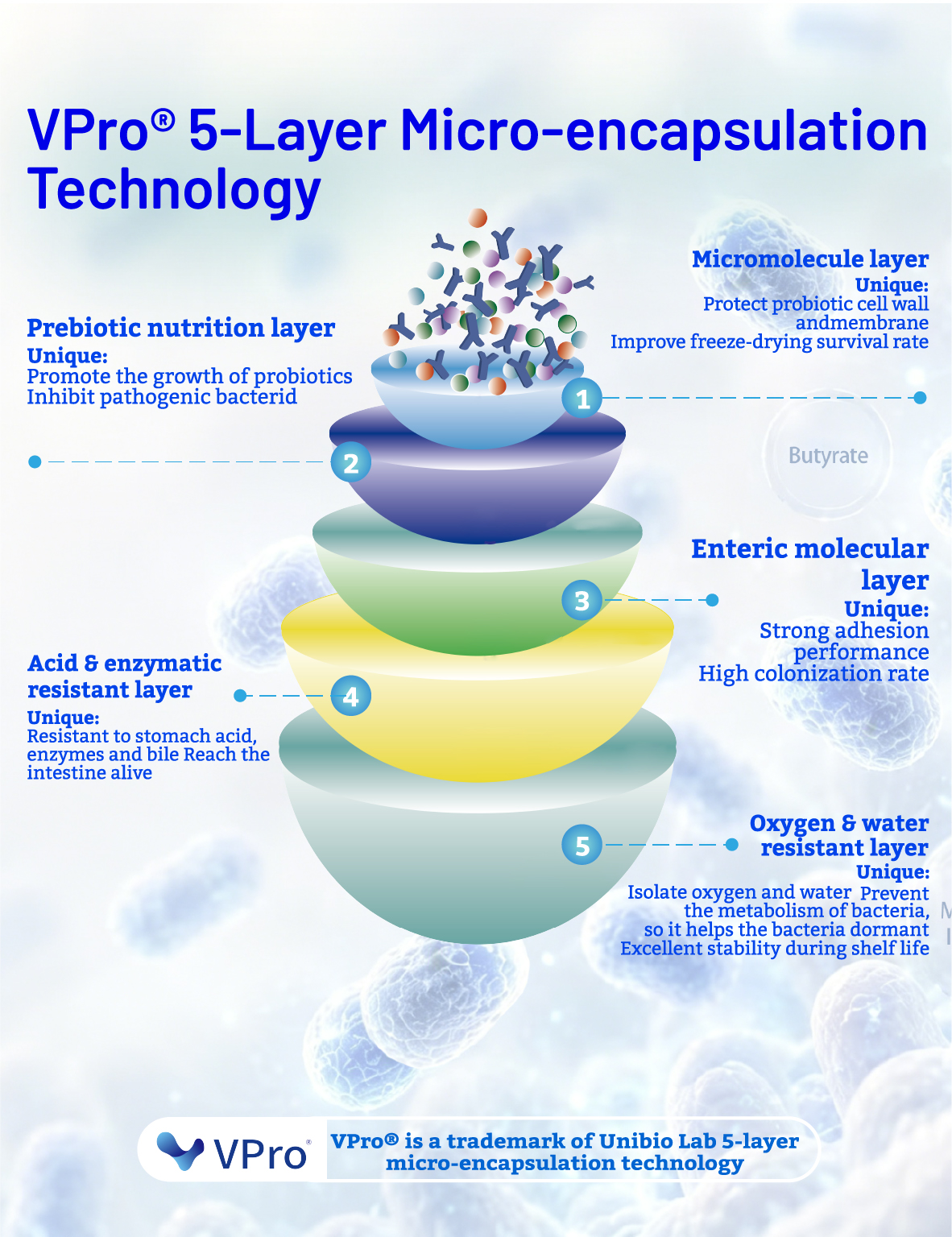
VPro® 5-layer micro-encapsulated probiotics material (model VPro®-5L-COAT) — a food-grade polysaccharide and protein composite coating matrix used to protect probiotic powder during processing, transport and shelf life.
A probiotics powder is only fully specified once four things are named: the strain designation, the viable count and the unit it is measured in, the carrier and protective matrix, and the storage condition the product was validated under. Two powders sold under the same category name can behave completely differently in a capsule, sachet, pet chew or beverage, because those four variables decide how many live cells actually survive to the end of shelf life.
This guide is written for formulators, supplement brands and procurement teams working at the awareness and research stage. It explains how to read a probiotic raw powder specification, how to weigh live probiotic powder against heat-inactivated postbiotic raw powder and liposomal postbiotics, and how to judge when VPro® 5-layer micro-encapsulation and cold-chain storage are genuinely required rather than automatically assumed. Specification examples are drawn from the raw material range of Shanghai Unibio Lab Co., Ltd. (Helplifes), a probiotic R&D, manufacturing and CDMO enterprise headquartered in Shanghai, China.
Problem Definition: What a Probiotics Powder Specification Must Answer
A probiotic raw powder is dried microbial biomass blended with a carrier and, in most industrial products, protected by a coating matrix. The category name therefore describes a delivery format, not a fixed product. Two purchase orders can both read “probiotics powder, 200B” and still be different inputs, because they may differ in strain designation, in the unit behind the number, and in the storage regime the count was validated against.
Four questions decide whether powders can be compared at all:
- Which strain? Species name, subspecies where relevant, and the strain designation printed on the certificate of analysis.
- Which count, in which unit? CFU/g, cells/g or TFU/g, and whether the figure is defined at release or at end of shelf life.
- Protected how? Carrier only, or carrier plus an encapsulation matrix designed for acid, bile, oxygen and freezing stress.
- Stored how? Frozen, cold-chain at 2 °C–8 °C sealed storage, or room temperature in a sealed container.
Where specification risk concentrates is at the comparison stage. A frozen-stored, high-count powder and a room-temperature-stable powder are not interchangeable inputs for the same finished product, even when the marketing name and the headline number look similar. Reading the four parameters in order, before comparing price, is the practical way to avoid that error.
Industry Background: Why Strain-Level Specification Became a Buying Criterion
The global probiotics market was valued at USD 72.1 billion in 2024 and is projected to reach USD 165.1 billion by 2034, according to Global Market Insights. Within that total, probiotic dietary supplements reached a market size of USD 10.60 billion in 2026, with a forecast CAGR of 9.5% through 2031 (MarketsandMarkets). Application segments show the same direction: the global baby probiotics market was valued at USD 2.27 billion in 2024 and is projected to grow at a CAGR of 8.6% to USD 5.6 billion by 2035 (WiseGuyReports), while the pet biotics market is estimated to reach USD 1,232.5 million by 2030 at a 7.0% CAGR (MarketsandMarkets).
Regulation has tightened alongside volume. In the United States, probiotic supplements are regulated under 21 CFR Part 111 and must comply with current Good Manufacturing Practices (FDA / Eurofins). At ingredient level, ISO 22000 is the international food safety management system standard applicable to the probiotic production chain and incorporates HACCP principles (ISO / Winclove Probiotics). In parallel, microencapsulation using materials such as alginate or chitosan has become a recognised technical trend for carrying probiotic viability through gastric acid and bile salts (PMC / MDPI).
The supplier landscape is layered, which changes what a buyer should compare. Established ingredient players in the global probiotics market include Yakult Honsha with a 6.7% share, Danone S.A., ADM, Kerry Group and Novonesis, according to Global Market Insights; alongside them, specialist manufacturers compete on strain banks, encapsulation technology and documentation. Company size alone therefore says little about fit. The object of comparison should be the specification sheet, the certificate of analysis and the compliance file — not the brand name on the inquiry form.
Detailed Solution: The Four Specification Parameters, One by One
1. Strain Identity and Strain Designation
Species-level naming is not a specification. “Bifidobacterium longum” or “Lactobacillus rhamnosus” describes a species; the strain designation identifies the individual culture whose data, behaviour and paperwork you are buying. Industrial documentation normally states genus, species, subspecies where relevant, and a strain code — for example Bifidobacterium animalis subsp. lactis BL03, Bifidobacterium longum CCFM1195, Lactobacillus rhamnosus GG, Lactobacillus plantarum CCFM1143, Ligilactobacillus salivarius CCFM1215, Clostridium butyricum CCFM1299 and Akkermansia muciniphila AH39.
Strain origin is usually printed next to the designation, and it belongs to the product identity record. Bifidobacterium animalis subsp. lactis BL03 and Bifidobacterium longum CCFM1195 are documented with a stated origin of human gut and independent lab culture respectively, while several strains in the CCFM series are listed as independent lab culture. What matters operationally is consistency: the designation and origin on the specification sheet, the batch certificate of analysis and the finished-product label should describe the same culture. Shanghai Unibio Lab maintains a strain bank of more than 30,000 microbial strains, including 189 patented functional strains, which is the resource base from which these strain-level specifications are drawn.
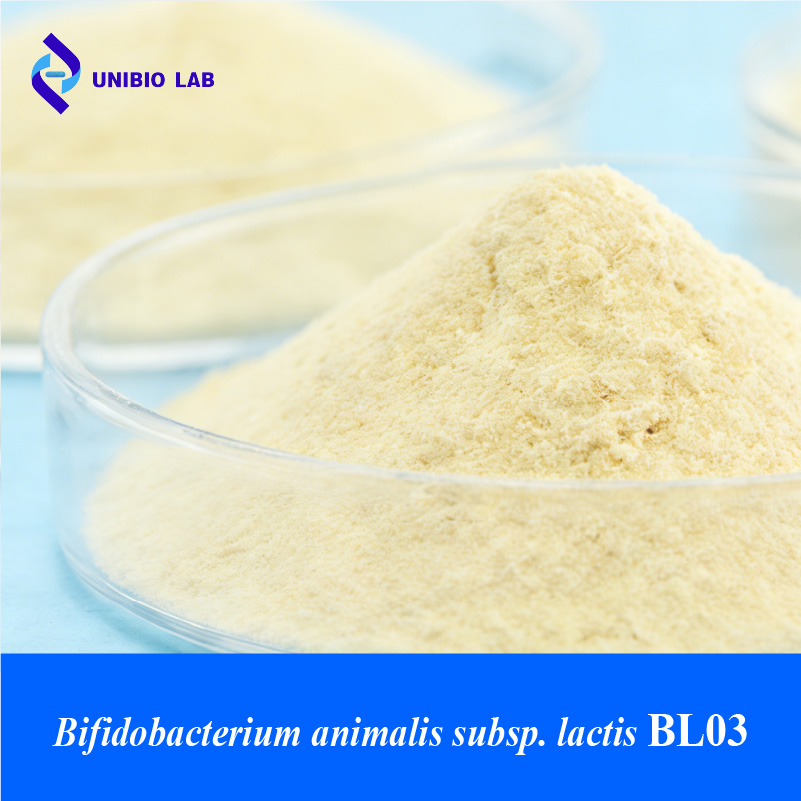
Bifidobacterium animalis subsp. lactis BL03 — single-strain probiotic powder, viable count 10B–600B CFU/g, human gut origin, supplied with maltodextrin carrier and VPro® 5-layer encapsulation material.
2. Viable Count: Range, Unit and Reference Basis
Count is written as a range rather than a single figure. Three specification examples from the same raw material range show how wide those ranges are: Bifidobacterium animalis subsp. lactis BL03 at 10B–600B CFU/g, Lactobacillus rhamnosus GG at 10B–300B CFU/g, and Bifidobacterium longum CCFM1195 at 10B–200B CFU/g. A higher number is not automatically a better input — the count has to match the target dose per serving, the finished dosage form, and the amount of the powder the formulator can physically include in the blend.
Unit consistency is the second half of this parameter. Most strains declare CFU/g (colony-forming units). Two documented exceptions show why the unit must be read before the number is compared: Lactobacillus rhamnosus CCFM1219 is specified as a total cell count of 10B–200B cells/g, and Akkermansia muciniphila AH39 is specified as 10B–200B TFU/g. A buyer comparing “200B” across these three units is comparing three different measurements. The third check is reference basis: the specification sheet and the batch certificate of analysis should state the count on the same basis, so that the number on the label claim and the number on the incoming goods test can be reconciled.
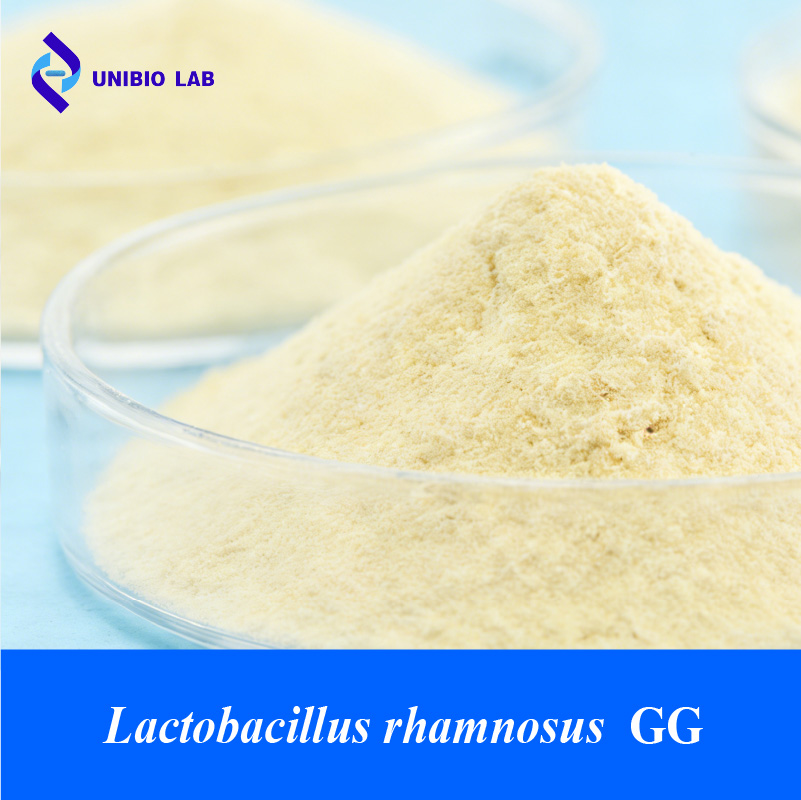
Lactobacillus rhamnosus GG — probiotic raw powder with a viable count of 10B–300B CFU/g, stored at −18 °C or below in sealed package, with maltodextrin carrier and VPro® 5-layer encapsulation material.
The table below summarises documented strain specifications from this range so that count, storage and composition can be read together.
| Strain (species + designation) | Viable count range | Documented storage |
|---|---|---|
| Bifidobacterium animalis subsp. lactis BL03 | 10B–600B CFU/g | Sealed package at −18 °C or below |
| Lactobacillus rhamnosus GG | 10B–300B CFU/g | Sealed package at −18 °C or below |
| Bacillus coagulans CCFM1041 (−39) | 10B–300B CFU/g | Room temperature, well-closed container |
| Streptococcus thermophilus ST67 | 10B–300B CFU/g | Sealed package at −18 °C or below |
| Bifidobacterium longum CCFM1195 | 10B–200B CFU/g | Room temperature, well-closed container |
| Bifidobacterium longum CCFM760 | 10B–200B CFU/g | Room temperature, well-closed container |
| Bifidobacterium breve CCFM1025 | 10B–200B CFU/g | Room temperature, well-closed container |
| Lactobacillus plantarum CCFM8724 | 10B–200B CFU/g | 2 °C–8 °C sealed cold storage |
| Ligilactobacillus salivarius CCFM1215 | 10B–200B CFU/g | 2 °C–8 °C sealed cold storage |
| Akkermansia muciniphila AH39 | 10B–200B TFU/g | Room temperature, well-closed container |
| Clostridium butyricum CCFM1299 | 10B CFU/g | Room temperature, well-closed container |
Shelf life is 24 months under recommended storage across these raw powder specifications. Declared composition for the listed strains is probiotic strain + maltodextrin carrier + VPro® 5-layer encapsulation material, unless otherwise stated on the specification sheet.
3. Carrier and Protective Matrix: Maltodextrin and VPro® 5-Layer Encapsulation
Maltodextrin appears as the standard carrier across the range, including in BL03, CCFM1195, CCFM760, CCFM1025, CCFM8724 and CCFM1215. Functionally it does two things for a formulator: it sets the bulk and flow behaviour of the powder during blending and dosing, and it defines the “per gram” basis on which the viable count is expressed. Because of that, carrier level and declared count are linked — a specification should be read as a complete composition, not as an isolated CFU/gram figure.
VPro® 5-layer micro-encapsulation (model VPro®-5L-COAT) sits on top of the carrier as a protective coating. It is a food-grade polysaccharide and protein composite coating matrix constructed from five functional layers: a micromolecular protective layer for anti-freezing and anti-stress protection; a prebiotic nutrition layer that supports in-vivo proliferation; a liposome enteric adhesion layer that supports intestinal colonization; an acid and enzyme resistant layer for survival through gastric digestion; and an oxygen and moisture barrier layer that extends shelf stability. The technology is documented as lifting freeze-drying survival rate by 40%, extending shelf life to 24 months, supporting fermentation density above 3.5×10¹⁰ CFU/mL and lyophilized powder concentration up to 8.0×10¹¹ CFU/g.
Selecting encapsulation is a decision about the process and the route to market, not about prestige. Three conditions make VPro® 5-layer encapsulation the relevant choice: the finished product passes through a high-temperature food process; the material travels long-distance export routes; or the retail format is room-temperature. For a frozen, cold-chain, short-route supplement programme with a low-stress fill process, the encapsulation layer is a lower priority than consistent batch documentation.
Encapsulation also carries a handling boundary. The microcapsule structure must not be crushed or extruded, which is why the matched equipment for these materials is a low-temperature storage cabinet together with a vacuum packaging machine and powder mixing equipment. The coating protects the strain in the finished product; it does not remove a strain-specific cold-chain requirement, and it does not survive abusive compression during tableting or blending.
4. Storage and Cold Chain: Three Regimes, Not One Standard
Storage conditions belong to the strain, not to buyer preference. Specifications in this range use three distinct regimes:
- Sealed package at −18 °C or below: Bifidobacterium animalis subsp. lactis BL03, Lactobacillus rhamnosus GG, Lactobacillus plantarum CCFM1143, Lactobacillus reuteri HR7, Lactobacillus acidophilus L59, Lactobacillus rhamnosus LR663, CCFM0528, Bifidobacterium adolescentis CCFM1173 and Streptococcus thermophilus ST67.
- 2 °C–8 °C sealed cold storage: Lactobacillus plantarum HP59, CCFM8724, CCFM602 and CCFM8661, Ligilactobacillus salivarius CCFM1215, and Lactobacillus delbrueckii subsp. bulgaricus HB68.
- Room temperature, well-closed container away from moisture and direct sunlight: Bifidobacterium longum CCFM1195 and CCFM760, Bifidobacterium breve CCFM1025, Lactobacillus rhamnosus CCFM1219, Akkermansia muciniphila AH39, Clostridium butyricum CCFM1299, Bacillus coagulans CCFM1041, and the postbiotic raw powders described below.
Two practical consequences follow. First, a formulation that mixes strains from two different regimes inherits the stricter one for storage and transport, which has a direct effect on logistics design and on what the finished product label may claim. Second, shelf life of 24 months is documented for these raw powders under recommended storage; a cold-chain logistics scheme is therefore part of the specification conversation, not an afterthought at shipment. Moisture-proof and light-proof transport conditions apply across the range.
Comparison Table: Live Probiotic Powder vs. Inactivated Postbiotic Powder vs. Liposomal Postbiotics
Not every formulation goal requires live bacteria. Where a finished product cannot protect a live count — a heat-processed food, an ambient beverage, or a skincare base — an inactivated or liposomal postbiotic input may be the more honest specification. The comparison below uses documented product data only.
| Specification point | Live probiotic raw powder (example: BL03) | Live, room-temperature stable (example: CCFM1195) | Heat-inactivated postbiotic powder (UNI-POST-POW) | Liposomal postbiotic (ProLipo-POST) |
|---|---|---|---|---|
| Live bacteria | Yes — viable count is the declared claim | Yes — viable count is the declared claim | No live bacteria contained | Postbiotic lysate; not specified as a live count |
| Declared content | 10B–600B CFU/g | 10B–200B CFU/g | Active postbiotic content ≥ specified value | Postbiotic lysate with phospholipid liposome wall material |
| Composition | Probiotic strain, maltodextrin carrier, VPro® 5-layer encapsulation material | Probiotic strain, maltodextrin carrier, VPro® 5-layer encapsulation material | Inactivated probiotic biomass, maltodextrin carrier | Postbiotic lysate, phospholipid liposome wall material, food-grade carrier |
| Storage | Sealed package at −18 °C or below | Room temperature, well-closed, away from moisture and direct sunlight | Room temperature, well-closed, away from moisture and direct sunlight | Room temperature, well-closed, away from moisture and direct sunlight |
| Shelf life | 24 months under recommended storage | 24 months under recommended storage | 24 months | 24 months |
| Typical application | Dietary supplement, food & beverage, pet health products, animal feed | Dietary supplement, food & beverage, health product | Functional food, dietary supplement, skincare raw material, beverage | High-end dietary supplement, luxury skincare, premium functional beverage |
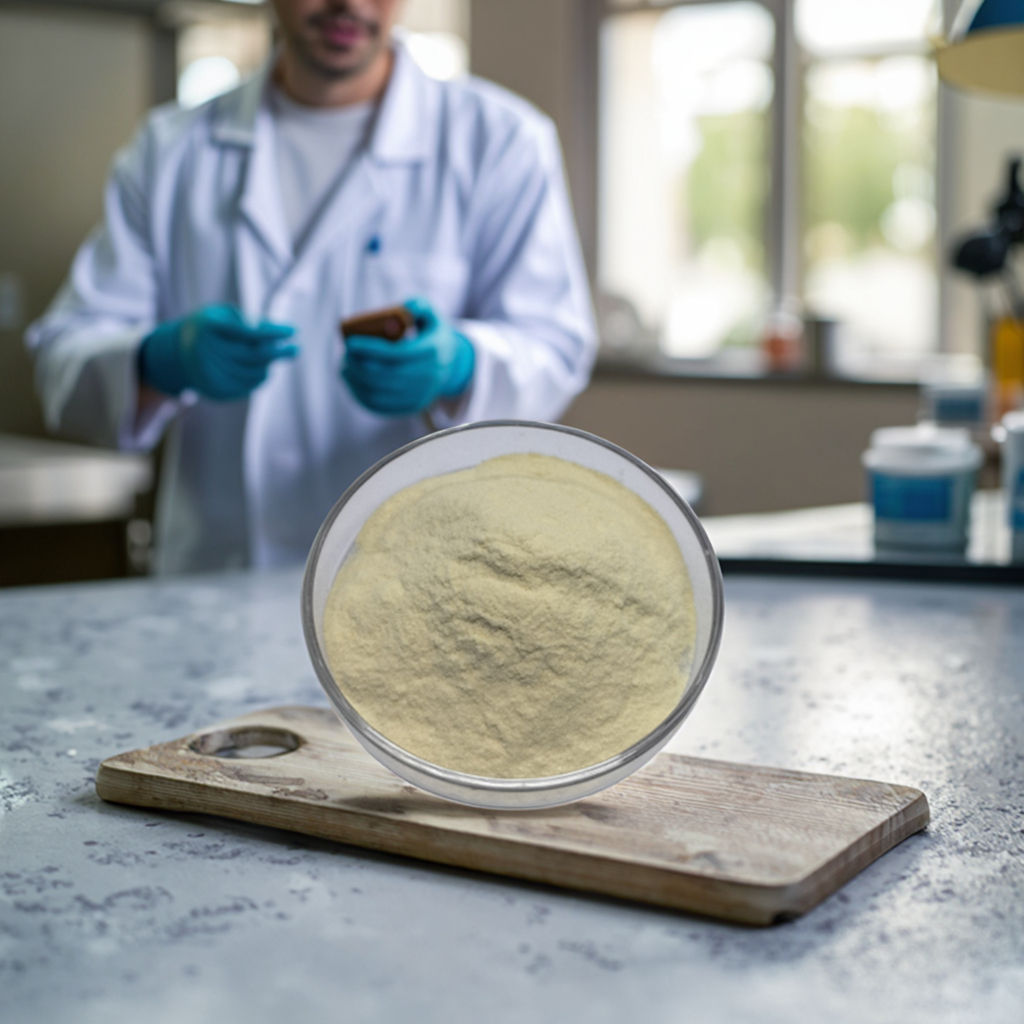
Postbiotics Powder (model UNI-POST-POW) — heat-inactivated postbiotic raw powder made from inactivated probiotic biomass and maltodextrin carrier, containing no live bacteria, with 24-month shelf life at room temperature.
Step-by-Step: How to Specify a Probiotics Powder for Your Formulation
The sequence below turns the four parameters into a workable specification and an order that can be verified on receipt.
Step 1 — Define the finished format and the target dose
Decide first whether the powder goes into a capsule, sachet, stick pack, chewable, pet powder, beverage or fermented dairy system. The format determines how much powder the blend can carry, which in turn determines the viable count range you can actually work with.
Step 2 — Fix the strain identity
Name the strain to designation level, for example Bifidobacterium animalis subsp. lactis BL03, Bifidobacterium longum CCFM1195 or Lactobacillus rhamnosus GG, and require the same designation on the specification sheet, certificate of analysis and label.
Step 3 — Agree the count, the unit and the basis
State the count as a range, confirm whether it is expressed in CFU/g, cells/g or TFU/g, and agree the reference basis used for release and for incoming goods testing. A specification that is silent on the unit cannot be verified later.
Step 4 — Choose the protection level
Decide between carrier-only and carrier plus VPro® 5-layer encapsulation material, based on process temperature, export distance and retail storage format. Where encapsulation is specified, confirm that downstream blending and tableting will not crush the microcapsule structure.
Step 5 — Lock storage and transport
Select the strain-appropriate regime: −18 °C or below, 2 °C–8 °C sealed storage, or room temperature in a well-closed container. Confirm the cold-chain logistics scheme and the moisture-proof, light-proof transport conditions in the supply agreement.
Step 6 — Verify the documentation package
Ask for the compliance set that matches your destination market: ISO 22000, FSSC 22000 and GMP food manufacturing certification, HALAL and OU Kosher certificates where relevant, and FDA US food facility registration for the United States, where probiotic supplements fall under 21 CFR Part 111. Require a batch certificate of analysis covering viable count, heavy metals and microbial safety, and confirm that third-party SGS or Intertek inspection can be arranged on request. For Akkermansia muciniphila AH39, an independent sGRAS conclusion supports US market documentation.
Step 7 — Confirm MOQ, lead time and sample route
Commercial terms should be fixed before formulation work is finalised: minimum order quantity of 1 kg for single-strain powder, 5 kg for compound powder and 5,000 bottles for finished HelpGut® products; lead time of 5–7 days for bulk raw materials and 25–35 days for private label finished goods; trade terms available as FOB Shanghai, CIF, DDU or DDP. Sampling at this stage lets you verify blend behaviour and count before committing volume.
Use Cases: Matching Strain, Count and Encapsulation to the Application
Specification choices become clearer when they are tied to a concrete application. The examples below are documented application positions for strains in this range, not general claims about the strains themselves.
- Infant and children’s nutrition: Lactobacillus rhamnosus GG is positioned for infant food as well as food & beverage, dietary supplement and health product applications; Lactobacillus reuteri HR7 is positioned for infant health products and dietary supplements; BL03 is positioned for food & beverage, dietary supplement, pet health products and animal feed.
- Adult gut and bowel regulation: Bifidobacterium longum CCFM760 is applied for intestinal balance, constipation relief and animal feed; Bifidobacterium adolescentis CCFM1173 and Lactobacillus plantarum CCFM1143 are positioned for intestinal balance, constipation relief and metabolic management respectively.
- Metabolic management: Akkermansia muciniphila AH39 is specified at 10B–200B TFU/g for dietary supplement, metabolic management and health product applications; Clostridium butyricum CCFM1299 is a butyrate-producing powder for dietary supplement, metabolic management and health product use.
- Pet and animal nutrition: BL03 and CCFM760 carry animal feed positioning, while Bacillus coagulans CCFM1041 covers food & beverage, dietary supplement and animal feed with a 10B–300B CFU/g range.
- Fermented dairy and DVS systems: Lactobacillus delbrueckii subsp. bulgaricus HB68 and Streptococcus thermophilus ST67 are fermentation DVS powders for fermented dairy, food & beverage, and yogurt starter applications.
- Oral care: Ligilactobacillus salivarius CCFM1215 is positioned for oral health products, dietary supplements and food & beverage, and is the core strain of the oral care chewable tablet specification at 10 billion CFU per tablet.
- Broad gut-health programmes: Lactobacillus rhamnosus CCFM0528 is documented as suitable for infant and adult gut health, immunity support, elderly and sports nutrition applications, and pet probiotics.
- Ambient-format products: where the retail format cannot carry a cold chain, CCFM1195, CCFM760, CCFM1025, CCFM1219, AH39, CCFM1299 and CCFM1041 are specified for room-temperature storage, and the inactivated and liposomal postbiotic powders are room-temperature inputs by design.
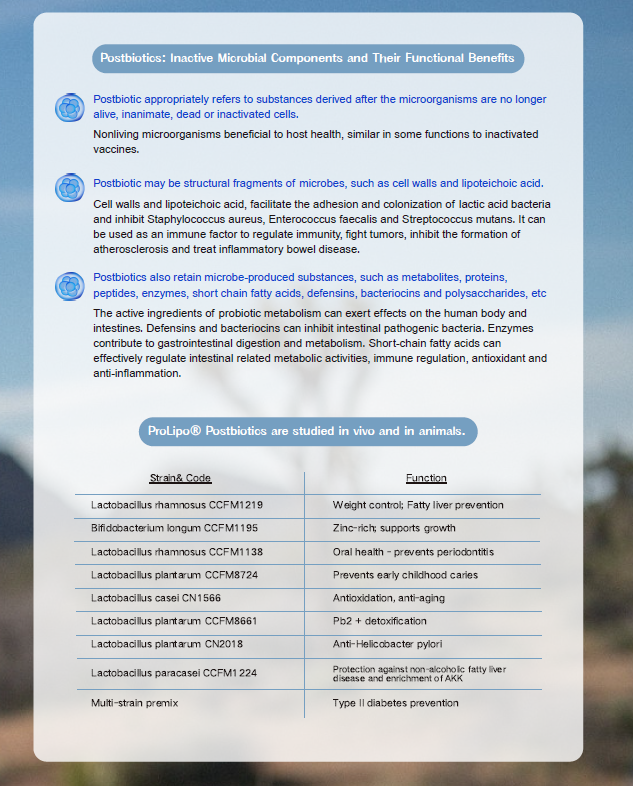
ProLipo® Postbiotics (model ProLipo-POST) — postbiotic lysate carried in a phospholipid liposome wall material with a food-grade carrier, stored at room temperature with a 24-month shelf life.
FAQ: Probiotics Powder Sourcing Questions
What certifications should I verify before buying probiotics powder?
For food and supplement applications, the core food-safety set is ISO 22000 and FSSC 22000, supplemented by GMP food manufacturing certification. Market-specific documents matter as well: HALAL and OU Kosher certificates for Muslim-majority and kosher markets, and FDA US food facility registration for the United States, where probiotic supplements are regulated under 21 CFR Part 111 and must comply with current Good Manufacturing Practices. Shanghai Unibio Lab holds ISO 22000, FSSC 22000, GMP food manufacturing certification (SGS), HALAL and OU Kosher certificates, and FDA US food facility registration, plus an independent sGRAS conclusion for Akkermansia muciniphila AH39. Every batch undergoes internal laboratory testing for viable count, heavy metals and microbial safety, and third-party SGS or Intertek inspection can be arranged on request.
Can viable count, strain blend and encapsulation be customised?
Yes, within documented ranges. Single-strain powders are supplied between 10B and 600B CFU/g depending on the strain — for example Bifidobacterium animalis subsp. lactis BL03 at 10B–600B CFU/g, Lactobacillus rhamnosus GG at 10B–300B CFU/g and Bifidobacterium longum CCFM1195 at 10B–200B CFU/g. Compound, multi-strain powders are also available. Customisation covers CFU concentration, dosage forms including powder, capsule, tablet, sachet and gummy, and personalised packaging design, with VPro® 5-layer encapsulation material and maltodextrin carrier as the standard protection system for the listed strains.
What are the storage and cold-chain requirements for probiotics powder?
Requirements are strain-specific and fall into three documented regimes. Sealed storage at −18 °C or below applies to strains such as BL03, Lactobacillus rhamnosus GG, CCFM1143, HR7, L59, LR663, CCFM0528, CCFM1173 and ST67. Sealed cold storage at 2 °C–8 °C applies to HP59, CCFM8724, CCFM602, CCFM8661, CCFM1215 and HB68. Room-temperature storage in a well-closed container away from moisture and direct sunlight applies to CCFM1195, CCFM760, CCFM1025, CCFM1219, AH39, CCFM1299, CCFM1041 and the postbiotic powders. Shelf life is 24 months under recommended storage. Transport must be moisture-proof and light-proof, and the microcapsule structure must not be crushed during handling; a cold-chain logistics scheme is provided for shipments that require it.
What are the MOQ and lead times for bulk probiotics powder?
Minimum order quantity is 1 kg for single-strain powder, 5 kg for compound powder and 5,000 bottles for finished HelpGut® products. Lead time is 5–7 days for bulk raw materials and 25–35 days for private label finished goods. Trade terms are available as FOB Shanghai, CIF, DDU or DDP. After-sales support includes free strain technical guidance, batch certificate of analysis provision, a cold-chain logistics scheme and a 24-hour working-hour complaint response.
How should I compare probiotics powder suppliers?
Compare four things, in this order. First, strain resources and documentation — a supplier with a broad bank of characterised strains can support strain-level specification instead of species-level substitution; Shanghai Unibio Lab maintains more than 30,000 microbial strains and 189 patented functional strains. Second, protection technology — whether the supplier owns a declared encapsulation system such as VPro® 5-layer micro-encapsulation, with documented effects on freeze-drying survival, heat resistance and shelf stability. Third, the compliance package for your specific destination market. Fourth, supply terms: MOQ, lead time, cold-chain capability and per-batch testing. Large established ingredient players such as Yakult Honsha, Danone S.A., ADM, Kerry Group and Novonesis are also part of the global probiotics market landscape, so a shortlist should be built on documented specification fit rather than brand size. If you want to validate a specification before shortlisting, request a sample and a quotation from Shanghai Unibio Lab Co., Ltd. at helplifes.com, or email kevin@helplifes.com with your target strain, count range and finished format.
Conclusion: Read the Specification Before You Compare the Price
Probiotics powder sourcing becomes manageable once the four parameters are separated. Strain identity is fixed to designation level. Viable count is agreed as a range, with the unit (CFU/g, cells/g or TFU/g) and the measurement basis stated explicitly. The protection system is chosen against the real process and route to market — maltodextrin carrier alone for low-stress, short-route programmes, or maltodextrin carrier plus VPro® 5-layer encapsulation material where heat, long-distance export or room-temperature retail formats are involved. Storage is then matched to the strain, whether that is −18 °C or below, 2 °C–8 °C sealed cold storage, or room temperature in a well-closed container, with a 24-month shelf life under recommended conditions.
Where a finished format cannot protect a live count, heat-inactivated postbiotic raw powder and liposomal postbiotics provide room-temperature alternatives with their own declared content and storage profiles. The point is not to rank one input above another, but to make sure the specification you order matches the claim your label will carry.
Shanghai Unibio Lab Co., Ltd. manufactures probiotic raw powder and postbiotics at an annual output of approximately 1,800 tons, supported by four self-owned manufacturing bases and one R&D centre in Shanghai, with a VPro® 5-layer encapsulation platform, an extensive strain bank and a compliance package covering North America, the EU, the Middle East and Southeast Asia.
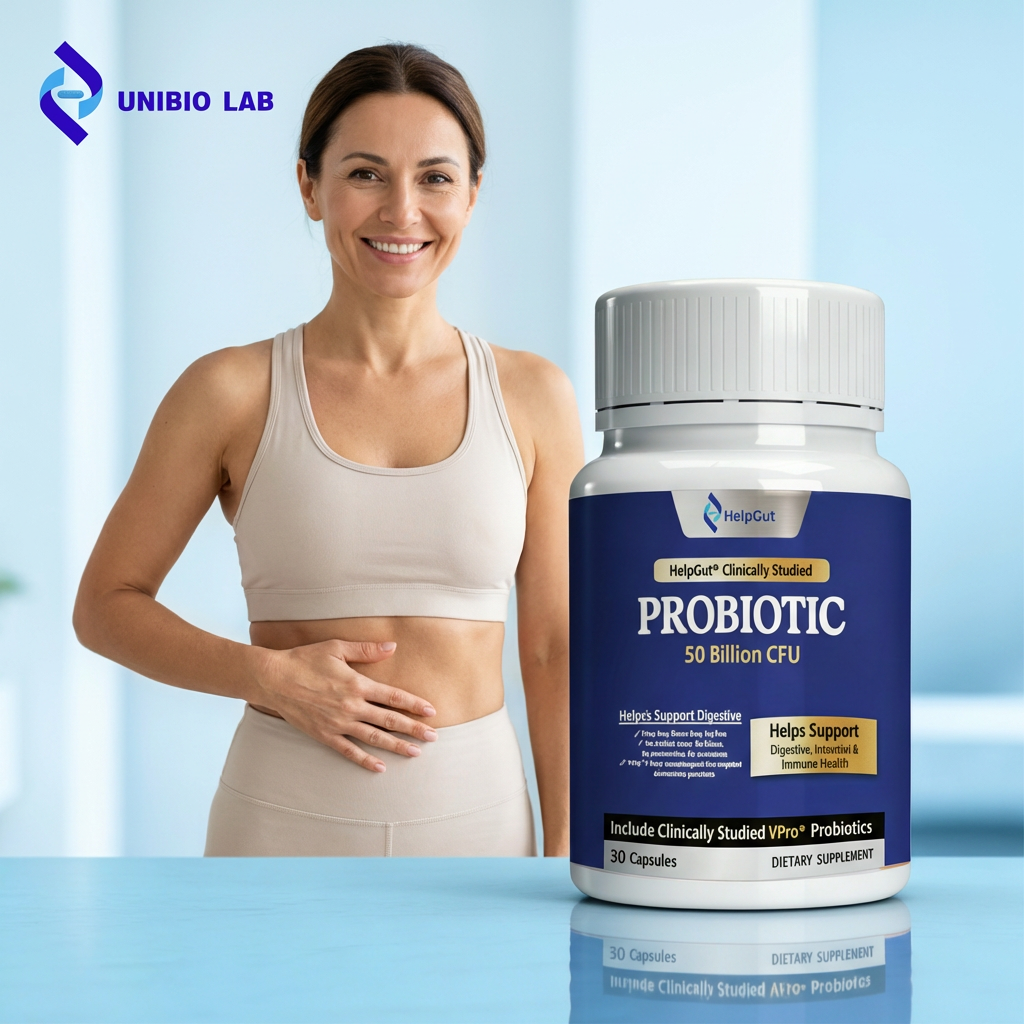
From raw powder to finished goods: HelpGut® 100B CFU Constipation Relief Probiotic Capsules (model HelpGut-CAP-CON100B), a vegetarian HPMC capsule with 100 billion CFU per capsule and a 24-month shelf life.
Next step: validate the specification before committing to a volume
If you are shortlisting probiotics powder suppliers, ask for three documents first — the specification sheet for the exact strain and count range, a batch certificate of analysis, and the compliance file for your target market. Samples, quotations and the complete product catalog are available from Shanghai Unibio Lab Co., Ltd.: email kevin@helplifes.com, call +86 135-1234-4323, or visit helplifes.com. The full brochure with strain and product details can be downloaded here.
Have Questions or Need More Details?
Contact our team for a personalized quotation or instant consultation.
Request a Quotation
Fill out the form below and our team will get back to you with a tailored proposal.
WhatsApp Direct Chat
Prefer to chat in real-time? Message us on WhatsApp for instant assistance & quick answers.
- Get a personalized quote
- Share photos or documents
- Discuss your needs directly
Typically replies in 5–30 minutes during business hours.