
What Is Butyrate-Producing Probiotic Powder? The Role of Clostridium Butyricum CCFM1299
A butyrate-producing probiotic powder is a powdered dietary-supplement ingredient built around bacterial strains whose fermentation activity generates butyrate in the gut. Clostridium Butyricum CCFM1299 is a defined example of that ingredient class: a Clostridium butyricum strain supplied by Shanghai Unibio Lab Co., Ltd as a butyrate-producing probiotic raw powder with a viable count of 10B CFU/g, a 24-month shelf life under recommended storage, and a composition of probiotic strain, maltodextrin carrier, and VPro® 5-layer encapsulation material.

Production line at Shanghai Unibio Lab Co., Ltd, where butyrate-producing probiotic raw powders are fermented, freeze-dried and encapsulated.
This explainer answers a narrow set of questions that formulators, brand owners and procurement teams actually ask when they encounter the term: what the classification means, how Clostridium butyricum differs from the more familiar Lactobacillus and Bifidobacterium strains, what sits inside a CCFM1299 powder, and where the verified specifications end and the marketing language usually begins.
What “Butyrate-Producing” Means in a Probiotic Powder
Butyrate is a short-chain fatty acid (SCFA) formed when gut bacteria ferment dietary fibre and related substrates in the colon. It is generally recognised as a principal energy source for the epithelial cells lining the colon, and it sits alongside acetate and propionate as one of the three main SCFAs produced by the gut microbiota.
When a raw material is labelled a “butyrate-producing probiotic powder,” the term describes the metabolic behaviour of the strain inside the formula — its capacity to generate butyrate through fermentation — rather than a finished-product health claim. That distinction matters commercially: an ingredient can be correctly described as butyrate-producing while the claim on a finished retail pack is governed separately by the regulatory framework of the market where it is sold.
Why the strain name has to appear in full
Clostridium butyricum is a spore-forming, Gram-positive anaerobic bacterium and is a recognised butyrate producer. Because it forms spores, it behaves differently from many vegetative Lactobacillus and Bifidobacterium strains during blending, tabletting and storage — a difference that directly affects how a supplier should build the powder.
Genus and species alone, however, are not a specification. ISAPP guidance on reading a probiotic label states that a compliant product label should identify the genus, species and strain designation, the viable count at the end of shelf life, and the storage conditions; the same guidance notes that products disclosing a strain designation are more likely to have evidence behind them. On that basis, “Clostridium butyricum” is a category, while Clostridium Butyricum CCFM1299 is a specification.
Why This Ingredient Class Is Moving (Industry Background)
The commercial backdrop is large and still expanding. MarketsandMarkets reports the global probiotics market at USD 76.59 billion in 2025, projected to reach USD 114.95 billion by 2030, a compound annual growth rate of 8.5%. Within that market, the bacterial probiotics segment accounts for the largest share, driven by widespread use in dietary supplements.
Format matters as much as strain. In the animal feed segment — a useful proxy for how buyers treat stability — the dry form led with an 84.7% revenue share in 2023. Powder is the dominant delivery format precisely because dry material tolerates long-distance shipping and ambient retail conditions better than liquid cultures.
That preference creates a technical obligation for butyrate producers. Clostridium butyricum is anaerobic, and oxygen and moisture exposure during blending and storage are the practical constraints on viability. The International Probiotics Association manufacturing guideline recommends keeping dosage-form manufacturing below 25 °C and below 60% relative humidity where acceptable, and moving to tighter refrigerated conditions if the delay between blending and dosage manufacturing exceeds 48 hours. For an export-oriented raw powder, that guideline has to be engineered into the material itself — which is what encapsulation layers are for.
Clostridium Butyricum CCFM1299: Identity, Classification and Specifications
The product is classified by its manufacturer as a Clostridium butyricum butyrate-producing probiotic powder, positioned for dietary supplement, metabolic management and health product applications. Its declared specification is as follows.
| Attribute | Declared Specification |
|---|---|
| Product name | Clostridium Butyricum CCFM1299 |
| Model / strain code | CCFM1299 |
| Ingredient type | Clostridium butyricum Butyrate-Producing Probiotic Powder |
| Viable count | 10B CFU/g |
| Composition | Probiotic strain; maltodextrin carrier; VPro® 5-layer encapsulation material |
| Strain origin | Independent lab culture |
| Storage conditions | Keep in a well-closed container away from moisture and direct sunlight at room temperature |
| Shelf life | 24 months under recommended storage |
| Applicable industries | Dietary Supplement; Metabolic Management Products; Health Product |
| Manufacturer | Shanghai Unibio Lab Co., Ltd (Shanghai, China) |
Two points in that table deserve attention during evaluation. First, the declared viable count is 10B CFU/g — buyers should confirm in writing whether the quoted figure is measured at the point of manufacture or at the end of the 24-month shelf life, because ISAPP recommends label disclosure at end of shelf life. Second, the storage statement is room temperature, not frozen. That is a deliberate formulation choice, not a default, and it is the result of the encapsulation system described below.
What Is Actually Inside the Powder
The composition lists three components, and each does a distinct job.
1. The probiotic strain — CCFM1299
The active ingredient is the Clostridium butyricum CCFM1299 strain itself. In a spore-forming species, the viable unit delivered to the blender is the spore, which is one reason C. butyricum raw powders can be standardised into ambient-stable formats more readily than strictly vegetative strains.
2. The maltodextrin carrier
Maltodextrin acts as the carrier matrix. It provides bulk so that a high-potency concentrate can be standardised to a declared CFU per gram, keeps the powder free-flowing during blending and filling, and reduces localised moisture migration around the cells.
3. The VPro® 5-layer encapsulation material
The coating matrix is a food-grade polysaccharide and protein composite. It is the component that separates a plain freeze-dried culture from a powder engineered for ambient storage and gastric transit.
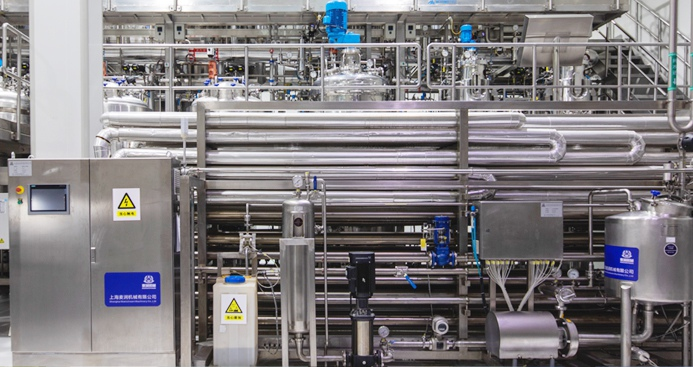
Blending and encapsulation area. Environmental control during blending is a decisive variable for anaerobic butyrate-producing strains.
How VPro® 5-Layer Microencapsulation Supports a Butyrate Producer
Shanghai Unibio Lab developed the VPro® five-layer embedding system to address four industrial failure points for probiotics: acid damage, bile damage, oxygen exposure, and freezing stress. Each layer has a defined function.
| Layer | Function |
|---|---|
| Micromolecular protective layer | Anti-freezing and anti-stress protection |
| Prebiotic nutrition layer | Supports in-vivo proliferation |
| Liposome enteric adhesion layer | Boosts intestinal colonisation |
| Acid & enzyme resistant layer | Survival through gastric digestion |
| Oxygen & moisture barrier layer | Extends shelf stability |
For a butyrate-producing powder specifically, the oxygen and moisture barrier layer carries the most commercial weight: anaerobic strains are the most sensitive to oxidative stress during transport and retail display. The acid and enzyme resistant layer addresses the other half of the problem — delivering the strain through the stomach so that it reaches the colon, where butyrate fermentation actually takes place.
The manufacturer reports the following process outcomes for the VPro® system:
- Freeze-drying survival rate lifted by 40%
- Shelf life extended to 24 months
- Fermentation density above 3.5×10¹⁰ CFU/mL
- Lyophilised powder concentration up to 8.0×10¹¹ CFU/g
Step-by-Step: From Strain Bank to Finished Butyrate-Producing Powder
Understanding the production sequence helps buyers identify which stage to question when a sample behaves unexpectedly. The manufacturer’s process runs as follows.
- Strain selection and banking. CCFM1299 is drawn from a proprietary strain bank of more than 30,000 microbial strains. The strain originates from independent lab culture, and the single-strain identity is fixed at this stage — once the strain designation is agreed in the specification, it should not change between sample and bulk.
- Fermentation. Production uses high-density ion-exchange culture combined with automatic feedback feeding and biofilm stabilisation techniques. This is the stage that determines cell density going into the freeze dryer, and it is where the reported fermentation density above 3.5×10¹⁰ CFU/mL is achieved.
- Freeze-drying. The culture is lyophilised. For an anaerobic, spore-forming species this step is also a stress event, which is why the micromolecular protective layer is relevant here.
- VPro® 5-layer encapsulation. The dried cells are coated with the food-grade polysaccharide and protein composite matrix described above.
- Blending and standardisation. Encapsulated cells are blended with the maltodextrin carrier to reach the declared 10B CFU/g and a consistent particle size.
- Quality control. Every batch is tested in-house for viable count, microbial safety and heavy metals. Third-party inspection by SGS or Intertek is available at the buyer’s request, and a batch quality report is issued with the shipment.
- Dosage form and packaging. Depending on the project, the material ships as bulk raw powder or is further processed into powder sachets, capsules, tablets or gummies under the manufacturer’s OEM, ODM, private label or custom-formula services.
Use Cases: Where a Butyrate-Producing Powder Fits
Clostridium Butyricum CCFM1299 is declared for dietary supplement, metabolic management product and health product applications. In practice that translates into four recurring project types.
Adult gut-health lines and bowel-regulating formats
Because butyrate is a fermentation product of the colonic microbiota, the most direct application is in adult digestive and gut-health formulations — typically capsules or stick-pack powders, where the strain contributes a non-Lactobacillus, spore-forming component to an otherwise conventional blend.
Metabolic management positioning
The strain is classified by the manufacturer under metabolic management products. Brands building a metabolic or weight-management range often use a butyrate producer as the spore-forming anchor alongside other strains targeted at metabolic endpoints.
Multi-strain blends
A spore-forming strain can be combined with Lactobacillus and Bifidobacterium strains in a single powder. Compound-blend projects are supported by custom strain combination and formulation optimisation services, with a minimum order quantity of 5 kg for multi-strain compound powder.
Ambient-stable retail formats
Because the declared storage condition is room temperature with a 24-month shelf life, the powder suits retail channels where cold chain is impractical. That is the point of pairing it with VPro® encapsulation rather than selling a naked freeze-dried culture.
Regional fit matters too. The HALAL certification held by the manufacturer explicitly covers Clostridium Butyricum CCFM1299, which removes one of the most common documentation obstacles for supplement brands selling into Southeast Asia and the Middle East.
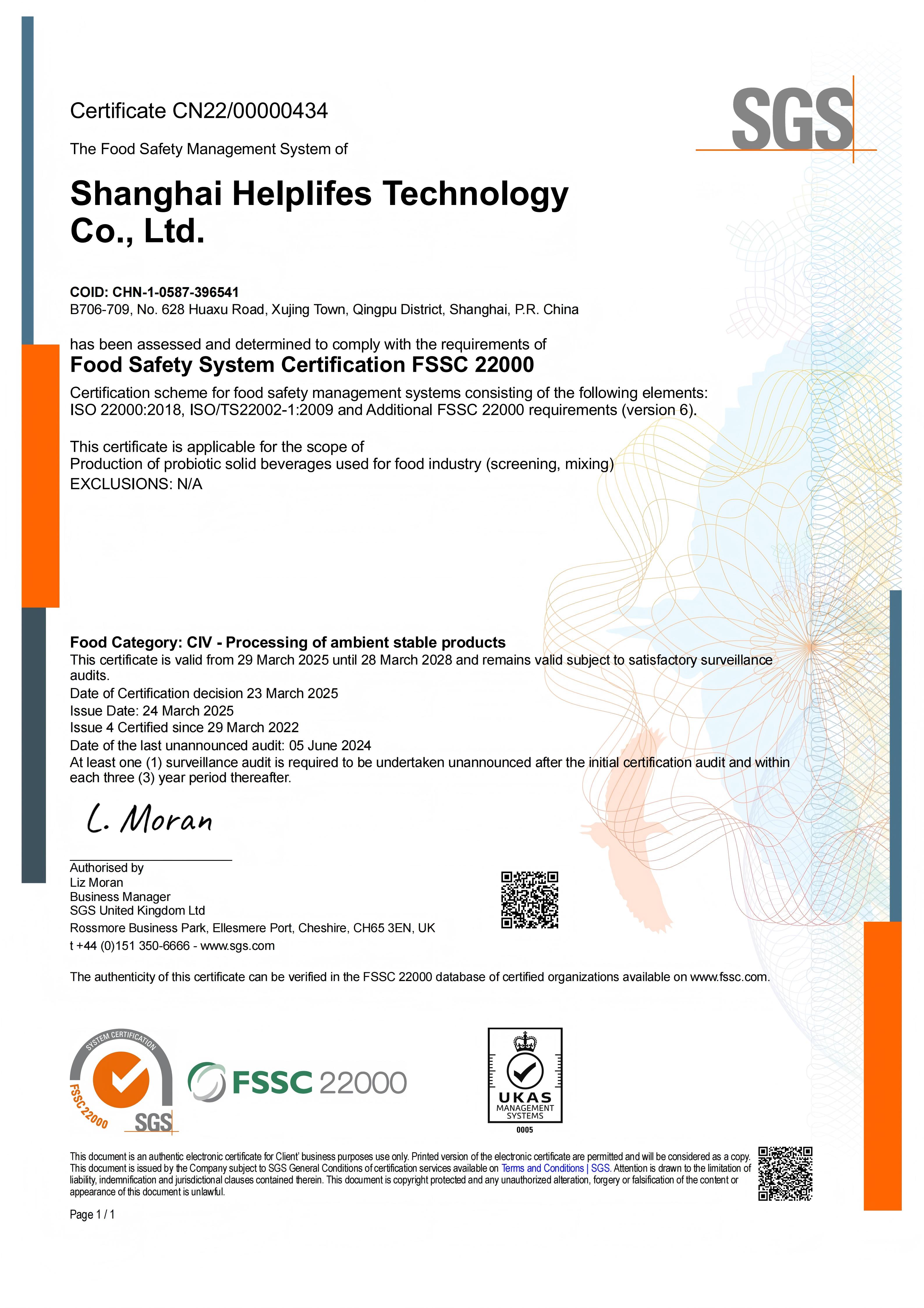
FSSC 22000 certificate No. CN22/00000434, issued by SGS United Kingdom Ltd, covering production of probiotic solid beverages (screening, mixing).
Comparison: CCFM1299 Alongside Other Probiotic Raw Powders
Butyrate-producing powder is one option inside a broader raw-material portfolio. The table below compares CCFM1299 with three other single-strain powders from the same manufacturer, using only declared product data.
| Product | Model | Type / Positioning | Viable Count | Storage | Shelf Life |
|---|---|---|---|---|---|
| Clostridium Butyricum CCFM1299 | CCFM1299 | Butyrate-producing probiotic powder; dietary supplement, metabolic management and health product | 10B CFU/g | Room temperature, sealed, away from moisture and direct sunlight | 24 months |
| Akkermansia muciniphila AH39 | AH39 | High-purity next-generation strain for metabolic management | 10B–200B TFU/g | Room temperature, sealed, away from moisture and direct sunlight | 24 months |
| Bacillus coagulans CCFM1041 (-39) | CCFM1041 | Heat-resistant spore-forming probiotic powder | 10B–300B CFU/g | Room temperature, sealed, away from moisture and direct sunlight | 24 months |
| Bifidobacterium longum CCFM760 | CCFM760 | Bifidobacterium raw powder for gut flora and constipation-relevant formats | 10B–200B CFU/g | Room temperature, sealed, away from moisture and direct sunlight | 24 months |
The comparison is not a ranking. It shows where CCFM1299 sits technically: it is the only butyrate-producing, spore-forming Clostridium option in the group, and its declared concentration is fixed at 10B CFU/g rather than offered across a wide potency band. A brand needing a higher declared CFU per gram in the finished blend would typically increase the inclusion rate in the formula or ask the supplier whether a custom concentration can be produced, rather than assume the standard spec is adjustable.
Specification and Sourcing Checklist for Buyers
When evaluating any butyrate-producing probiotic powder, the same qualification logic applies. The points below are the ones that most often separate a compliant purchase from a costly resupply.
- Strain designation in writing. Confirm the full strain code (CCFM1299) on the specification sheet, the Certificate of Analysis and the commercial invoice — not only on the marketing page.
- End-of-shelf-life count. State in the purchase specification whether the declared viable count is at manufacture or at end of shelf life. ISAPP recommends end-of-shelf-life disclosure, and the gap between the two can be significant.
- Encapsulation on the CoA. If the material is priced as encapsulated, the coating should be identifiable in the product documentation. Confirm that the VPro® 5-layer encapsulation material is part of the delivered composition, not an optional extra.
- Batch-level safety testing. Viable count, microbial safety and heavy metals should be tested per batch. Third-party inspection by SGS or Intertek should be available on request.
- Storage validation for your route. Room-temperature stability is a claim that has to survive your warehouse, your co-packer and your distribution channel. Test the material under your own conditions before committing to a full run.
- Documentation pack for the destination market. Request the certificates relevant to the market of sale at quotation stage, not after the order is placed.
- Ask vendors for scientific support. The Council for Responsible Nutrition recommends asking suppliers for scientific support linking the specific strains, in their labelled amounts, to the benefits claimed. That question is as valid for a raw-material supplier as for a finished-goods vendor.
Compliance Reference Points for Clostridium Butyricum CCFM1299
The manufacturer, Shanghai Unibio Lab Co., Ltd, holds the following documentation relevant to this material.
| Document | Reference | Coverage Relevant to CCFM1299 |
|---|---|---|
| HALAL Certificate (Indonesian BPJPH recognised) | Registration No. 3100/11080; Certificate No. 1821240000; valid 26 Jul 2025 – 25 Jul 2028 | Scope explicitly includes Clostridium Butyricum CCFM1299 and related raw materials and finished products |
| FDA Facility Registration | Shanghai Unibio Lab Co.,Ltd: 19635371796 | Covers probiotic raw material and finished dietary supplement production and sales |
| ISO 22000 Food Safety Management System | CN22/00000437 | Probiotic solid beverage production (screening, mixing) |
| FSSC 22000 | CN22/00000434 | Probiotic solid beverage production (screening, mixing); Food Category CIV |
| GMP (Codex Alimentarius GHP) | CN22/00003036, issued by SGS-CSTC | Production of probiotic solid beverages (screening, mixing) |
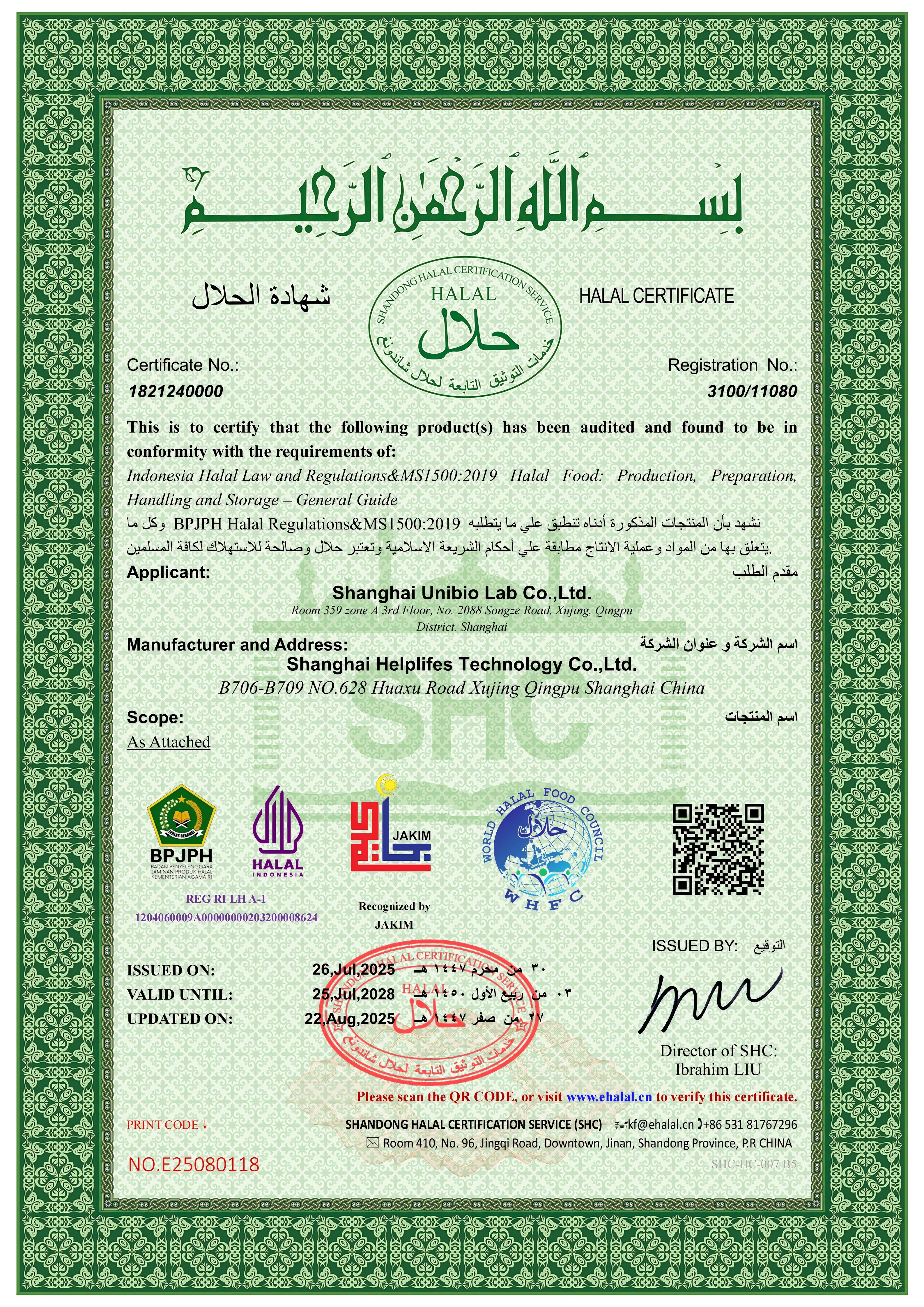
HALAL certificate covering all listed probiotic strains, including Clostridium Butyricum CCFM1299, plus related raw materials and finished products.
Frequently Asked Questions
Is Clostridium Butyricum CCFM1299 covered by the supplier’s food-safety and HALAL certifications?
Yes for HALAL, food-safety and facility documents. The HALAL certificate (Registration No. 3100/11080; Certificate No. 1821240000, valid 26 July 2025 to 25 July 2028) lists Clostridium Butyricum CCFM1299 within its scope, alongside the Bifidobacterium and Lactobacillus series and related raw materials and finished products. The manufacturer also holds ISO 22000 (CN22/00000437), FSSC 22000 (CN22/00000434) and Codex Alimentarius GMP certification (CN22/00003036, issued by SGS-CSTC), plus US FDA food facility registration number 19635371796. Note that the independent GRAS conclusion (No. CIRS-GRAS-AH39-20250422) applies only to Akkermansia muciniphila AH39 and does not extend to CCFM1299. Buyers should request the specific certificate set required for their destination market at quotation stage.
Can Clostridium Butyricum CCFM1299 be supplied as an OEM/ODM microencapsulated powder?
Yes. The material is supplied with VPro® 5-layer encapsulation material as part of its standard composition, and the manufacturer offers OEM, ODM, private label and custom formula development services. Customisation covers probiotic strain combination, viable CFU concentration, powder/bottle/capsule/tablet dosage form, packaging design, brand logo printing, prebiotic and excipient formula, and microencapsulation process adjustment. Production capacity behind these services is 1,800 tons of probiotic raw powder and postbiotics powder annually, plus 2 billion finished capsules or tablets per month. The encapsulation technology is supported by high-density ion-exchange culture, automatic feedback feeding and biofilm stabilisation techniques.
What is the minimum order quantity, and what drives the cost of a butyrate-producing powder?
Minimum order quantities are 1 kg for single-strain raw powder, 5 kg for multi-strain compound powder, and 5,000 bottles for private-label finished capsules or tablets. Trade terms available are FOB Shanghai, CIF, DDU and DDP. Cost is driven primarily by the declared viable count, the encapsulation specification, the dosage form, and the packaging configuration — so the practical way to compare quotations is to fix the strain, the CFU per gram, the encapsulation system and the delivery term first, then compare price against an identical specification. Payment terms include 100% advance payment, a 30-day credit period for trusted customers, and a 50% advance deposit with the balance due 30 days after bill of lading issuance.
How should a buyer validate a sample before committing to bulk?
Validation should start with documentation and end with your own stability trial. Every batch undergoes 100% in-house lab testing for viable count, microbial safety and heavy metals, and a batch quality report is provided; third-party inspection by SGS or Intertek is available on request. Beyond the CoA, ask three questions: whether the quoted CFU is at manufacture or end of shelf life, whether the VPro® encapsulation is confirmed in the delivered composition, and whether the strain designation CCFM1299 appears identically across the specification sheet, CoA and invoice. Then store the sample under your own warehouse and distribution conditions and retest the count before scaling.
What is the production lead time, and how do I move from sample to order?
Typical lead time is 5–7 days for raw material bulk orders and 25–35 days for private-label finished products. Sample validation and bulk orders therefore run on different clocks: a bulk raw powder order can ship within a week of confirmation, while a finished private-label run requires the longer window for blending, dosage-form manufacturing, packaging and QC. The next step is to request a Clostridium Butyricum CCFM1299 sample and a specification-matched quotation from Shanghai Unibio Lab Co., Ltd — you can reach the team at kevin@helplifes.com, on WhatsApp at +86 158-2126-0907, or through www.helplifes.com. Download the full product and capability brochure here.
Conclusion: Butyrate-Producing Powder Is a Specification, Not a Slogan
Butyrate-producing probiotic powder describes an ingredient class defined by metabolic output: strains whose fermentation activity generates butyrate in the colon. The category is commercially meaningful because dry powder dominates probiotic delivery, because buyers increasingly demand strain-level specification, and because anaerobic butyrate producers place unusual demands on encapsulation and storage.
Clostridium Butyricum CCFM1299 sits precisely at that intersection. It is a spore-forming Clostridium butyricum strain, declared at 10B CFU/g with a 24-month shelf life under room-temperature storage, built on probiotic strain, maltodextrin carrier and VPro® 5-layer encapsulation material, and classified for dietary supplement, metabolic management and health product applications. The verified facts stop there — and for a buyer, knowing exactly where the facts stop is what makes the specification usable.
Request a Sample or Specification-Matched Quote
Shanghai Unibio Lab Co., Ltd supplies Clostridium Butyricum CCFM1299 as bulk raw powder from 1 kg, as multi-strain compound powder from 5 kg, and as private-label finished capsules or tablets from 5,000 bottles — with batch-level quality reports and third-party inspection available on request.
Email kevin@helplifes.com | WhatsApp +86 158-2126-0907 | Website www.helplifes.com
Download the brochure: Probiotics Powder Product & Capability Brochure (PDF)
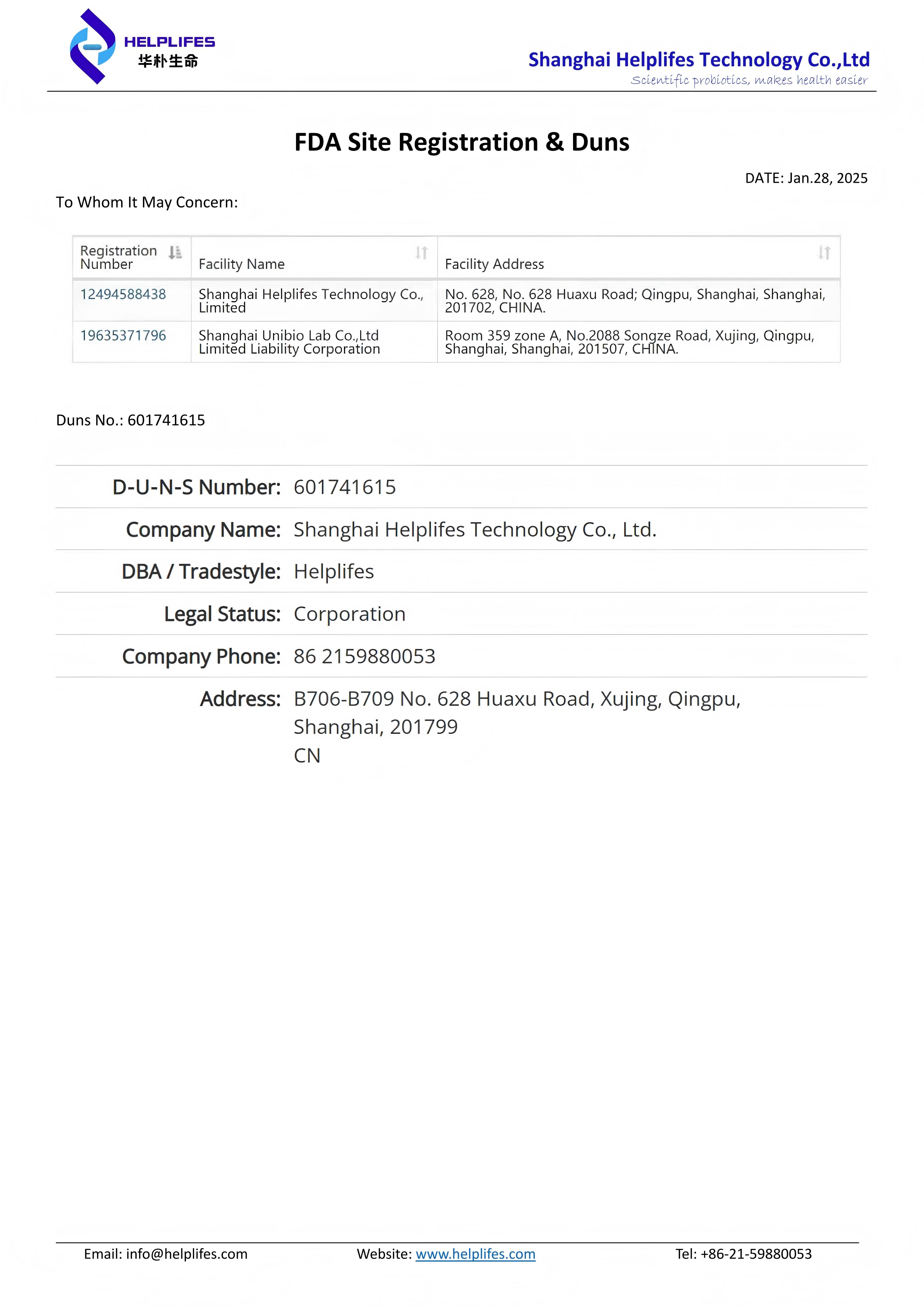
US FDA food facility registration covering probiotic raw material and finished dietary supplement production and sales.
Have Questions or Need More Details?
Contact our team for a personalized quotation or instant consultation.
Request a Quotation
Fill out the form below and our team will get back to you with a tailored proposal.
WhatsApp Direct Chat
Prefer to chat in real-time? Message us on WhatsApp for instant assistance & quick answers.
- Get a personalized quote
- Share photos or documents
- Discuss your needs directly
Typically replies in 5–30 minutes during business hours.