
What Is Probiotics Powder Made Of? Live Strains, Carriers, and Postbiotic Forms
Probiotics powder is not one ingredient. It is a material system: viable microbial strains, a carrier such as maltodextrin, and often a protective encapsulation layer. A different product category, postbiotic powder, replaces live cells with heat-inactivated biomass or postbiotic lysate. Understanding which materials are present — and why — is the first step in evaluating any probiotics powder specification.
This explainer breaks down the core composition of live probiotics powder, the role of carriers and the VPro® 5-layer micro-encapsulation material, and the alternative postbiotic forms represented by heat-inactivated Postbiotics Powder and ProLipo® Postbiotics. It uses named strains from the Shanghai Unibio Lab Co., Ltd portfolio — Bifidobacterium longum CCFM1195, Lactobacillus rhamnosus GG, and Lactobacillus plantarum HP59 — as concrete examples. Shanghai Unibio Lab Co., Ltd is a probiotic R&D, manufacturing, and CDMO enterprise based in Shanghai, China, founded in 2021.
Why Composition Matters Before You Compare Suppliers
The phrase "probiotics powder" is used across live cultures, heat-inactivated biomass, and blended formulations. On a specification sheet, a CFU figure alone does not tell a buyer which of these material systems is being offered. That ambiguity creates three practical problems.
First, live probiotics and postbiotics carry different storage, stability, and labeling implications. A powder that contains no live cells cannot support a viable-count claim at end of shelf life. Second, carriers are frequently listed without explaining their function, which makes it hard to judge whether the CFU figure has been standardized using a food-grade diluent or left as a concentrated culture. Third, encapsulation systems are often described with proprietary terms rather than with the actual material composition, which limits technical comparison.
Composition literacy changes the questions a buyer asks: Is the powder live or inactivated? Which strain, at which viable count, in which carrier? Is a protective coating applied, and what is it made of? Is the storage condition compatible with the intended distribution channel? These questions sit upstream of supplier selection and are answered by the material list, not by marketing language.
Industry Background: The Powder Format in Context
The global probiotics market was valued at USD 76.59 billion in 2025 and is projected to reach USD 114.95 billion by 2030, according to MarketsandMarkets (SRC-0001). The bacterial probiotics segment accounts for the largest share of that market (SRC-0001). Within application-specific segments, dry formats are dominant: in the animal feed probiotics market, the dry segment held an 84.7% revenue share in 2023 (SRC-0003).
The powder format's advantage is practical. Dry material is easier to store, transport, blend, and dose than liquid cultures. That advantage comes with a compositional cost: viable cells are sensitive to moisture, oxygen, heat, and gastric fluid, so the powder has to be engineered around those sensitivities.
Two guidance documents frame the manufacturing and labeling context. The International Probiotics Association manufacturing guideline recommends keeping probiotic dosage-form manufacturing below 25°C and below 60% relative humidity, with tighter refrigerated conditions if the delay between blending and dosage manufacturing exceeds 48 hours (SRC-0007). ISAPP's label guidance states that a probiotic product label should identify genus, species, strain designation, viable count at end of shelf life, and storage conditions (SRC-0005).
Those two documents point to the same conclusion: composition transparency is a technical requirement, not a marketing preference. A powder that does not disclose its strain identity, carrier, and viable-count basis is harder to verify and harder to formulate with.
What Probiotics Powder Is Made Of: Four Core Components
A live probiotics raw powder is built from four functional components. Each one can be described in material terms.
1. Live Probiotic Strains
The microbial component is the reason the product exists. Strains are identified at genus, species, and strain level, and the strain designation is what connects a powder to its supporting evidence.
Three examples illustrate how strain identity translates into a specification:
- Bifidobacterium longum CCFM1195 — viable count 10B–200B CFU/g; storage in a well-closed container away from moisture and direct sunlight at room temperature; shelf life 24 months under recommended storage; strain origin independent lab culture; listed for food & beverage, dietary supplement, and health product applications.
- Lactobacillus rhamnosus GG — viable count 10B–300B CFU/g; storage in a sealed package at -18°C or below; shelf life 24 months under recommended storage; strain origin independent lab culture; listed for food & beverage, dietary supplement, health product, and infant food.
- Lactobacillus plantarum HP59 — viable count 10B–200B CFU/g; storage at 2°C–8°C sealed cold storage; shelf life 24 months under recommended storage; strain origin independent lab culture; listed for food & beverage, dietary supplement, and fermented food.
The three examples also show that "room-temperature stable" is a strain-specific property, not a category-wide one. CCFM1195 is specified for room-temperature storage, GG for -18°C or below, and HP59 for 2°C–8°C. A buyer comparing powders without checking the storage line is comparing incomplete specifications.
2. Carriers Such as Maltodextrin
The carrier is the second material in the powder. In the Shanghai Unibio Lab product specifications, maltodextrin appears consistently as the carrier for both live probiotic raw powders and heat-inactivated postbiotic powder.
A carrier performs four functions in a powder system:
- Dilution and standardization. A concentrated fermentation or freeze-dried culture is blended down to a target viable count per gram. The carrier makes a 10B CFU/g or 200B CFU/g specification reproducible.
- Moisture management. A food-grade carrier reduces moisture migration within the powder matrix and helps protect viable cells during storage.
- Flow and handling. Carrier-blended powders flow more consistently through filling, blending, and dosing equipment.
- Blend consistency. In multi-strain formulas, the carrier provides a common base that helps distribute each strain evenly.
Carrier selection is not a neutral detail. The carrier type and ratio determine how much of the powder mass is active material versus diluent, and therefore how the CFU specification translates into a finished dose.
3. VPro® 5-Layer Micro-Encapsulation Material
Encapsulation is the third component in a protected live probiotics powder. Shanghai Unibio Lab's VPro® technology applies five functional layers to the strain:
- Micromolecular protective layer — anti-freezing and anti-stress protection during freeze-drying and handling.
- Prebiotic nutrition layer — supports in-vivo proliferation after ingestion.
- Liposome enteric adhesion layer — supports intestinal colonization.
- Acid and enzyme resistant layer — helps the strain survive gastric digestion.
- Oxygen and moisture barrier layer — extends shelf stability.
In material terms, the VPro®-5L-COAT coating is described as a food-grade polysaccharide and protein composite coating matrix. The company reports that the technology lifts the freeze-drying survival rate by 40% and extends shelf life to 24 months. Those are company-reported performance figures and should be confirmed against batch-level data during qualification.
The reason encapsulation matters is mechanical. A bare freeze-dried cell has limited protection against acid, bile, oxygen, and moisture. The coating adds a physical barrier, but it also adds mass and process complexity. The trade-off is explicit: better survival and shelf stability in exchange for a more involved manufacturing step.
4. Postbiotic Forms: Heat-Inactivated Powder and ProLipo®
The fourth component category is not an additive to live probiotics powder but a different product form. Two postbiotic materials illustrate the distinction.
Postbiotics Powder (UNI-POST-POW). Composition: inactivated probiotic biomass and maltodextrin carrier. The specification states that no live bacteria are contained. Storage is in a well-closed container away from moisture and direct sunlight at room temperature; shelf life is 24 months. Applicable industries listed are functional food, dietary supplement, skincare raw material, and beverage.
ProLipo® Postbiotics (ProLipo-POST). Composition: postbiotic lysate, phospholipid liposome wall material, and a food-grade carrier. Storage is in a well-closed container away from moisture and direct sunlight at room temperature; shelf life is 24 months. Applicable industries listed are high-end dietary supplement, luxury skincare, and premium functional beverage.
The structural difference is the wall material. Heat-inactivated Postbiotics Powder uses inactivated biomass plus maltodextrin. ProLipo® Postbiotics uses postbiotic lysate enclosed in a phospholipid liposome wall with a food-grade carrier. Both contain no live cells, which means neither supports a viable-count claim; their specifications are expressed in terms of active postbiotic content rather than CFU.
From Strain to Finished Powder: A Step-by-Step Breakdown
The composition list becomes clearer when mapped to the production sequence. For a live microencapsulated powder, the typical order is:
- Strain selection. A strain with documented identity, origin, and application fit is chosen. Strain-level designation is the anchor for later claims.
- Fermentation. The strain is cultured under controlled conditions. Shanghai Unibio Lab reports fermentation density above 3.5×10¹⁰ CFU/mL and lyophilized powder concentration up to 8.0×10¹¹ CFU/g under its process conditions.
- Concentration and biomass separation. Cells are separated from the fermentation medium using equipment such as aseptic disc centrifuges.
- Freeze-drying. Viable cells are stabilized by low-temperature vacuum drying.
- Encapsulation. The VPro® 5-layer coating is applied where the specification calls for it.
- Carrier blending. The concentrated material is blended with maltodextrin to reach the target CFU/g.
- Quality testing. In-house viable count, microbial safety, and heavy metal testing are performed. Third-party inspection by SGS or Intertek can be requested.
- Packaging. The powder is filled into moisture-barrier packaging for storage and shipment.
Each step changes the material that ends up in the bag. A buyer reading a specification is reading the output of this sequence, which is why the carrier line and the storage line are as informative as the CFU line.
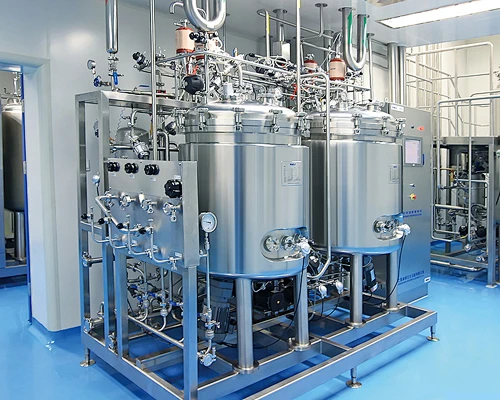
Probiotic powder production environment. Shanghai Unibio Lab Co., Ltd operates self-owned manufacturing bases and an R&D center in Shanghai.
How CFU/g Viability Ranges Are Expressed
Colony-forming units per gram (CFU/g) is the standard expression of viable count in a live probiotics powder. The range matters because the same strain can be supplied at different concentrations, and the chosen concentration affects dosage, cost, and stability.
Within the Shanghai Unibio Lab portfolio, common ranges include:
- 10B–200B CFU/g for many single strains, including Bifidobacterium longum CCFM1195 and Lactobacillus plantarum HP59.
- 10B–300B CFU/g for Lactobacillus rhamnosus GG and Bacillus coagulans CCFM1041 (-39).
- 10B–600B CFU/g for Bifidobacterium animalis subsp. lactis BL03.
- 10B CFU/g for Clostridium Butyricum CCFM1299.
Three conventions matter when reading these figures. First, the count should be tied to a defined point in the product lifecycle. ISAPP guidance recommends stating viable count at end of shelf life rather than only at production (SRC-0005). Second, the storage condition should be stated alongside the count, because a 200B CFU/g powder stored at -18°C and a 200B CFU/g powder stored at room temperature do not carry the same stability risk. Third, the CFU figure is not the same as total cell count; some specifications, such as Lactobacillus rhamnosus CCFM1219, are expressed as total cell count (10B–200B cells/g) rather than CFU/g.
A fourth convention is labeling. ISAPP guidance lists genus, species, strain designation, viable count at end of shelf life, and storage conditions as the core label elements (SRC-0005). A specification that omits the strain designation or the end-of-shelf-life basis is harder to verify against the label.
When to Choose Live Probiotics vs Postbiotics
The choice between live probiotics powder and postbiotic powder is a formulation decision, not a quality hierarchy. Each form has a defined role.
Live probiotics powder is the appropriate choice when:
- The finished product needs viable cells at the point of consumption, and the label will carry a CFU claim.
- The target application has strain-specific evidence that depends on live cells.
- Storage and distribution can maintain the required condition — room temperature for a strain like CCFM1195, -18°C or below for GG, or 2°C–8°C for HP59.
Postbiotic powder is the appropriate choice when:
- The formulation or distribution channel cannot reliably maintain live-cell viability.
- The product concept is built around non-viable postbiotic material rather than a CFU claim.
- The application calls for the specific material system — inactivated biomass plus maltodextrin for Postbiotics Powder, or postbiotic lysate in a phospholipid liposome wall for ProLipo® Postbiotics.
The main trade-off is straightforward. Live probiotics offer viable-cell functionality but carry tighter storage and handling requirements. Postbiotics remove the live-cell variable but do not support CFU claims. Encapsulation can narrow the gap for live strains, at the cost of an additional manufacturing step.
Use Cases Across Application Segments
Composition choices map to application segments. The strain list and the customer cases below illustrate how the same powder platform is configured differently.
Adult Gut and Bowel Regulation
Bifidobacterium longum CCFM1195 and Lactobacillus plantarum HP59 are both listed for dietary supplement and health product use, with viable counts in the 10B–200B CFU/g range. Bifidobacterium longum CCFM760 is listed for both human nutrition and animal feed.
Infant Nutrition
Lactobacillus rhamnosus GG is listed for infant food applications. Lactobacillus reuteri HR7 is listed for infant health products. Both are single-strain materials that can be blended into infant-oriented formulations.
Pet Nutrition
Bifidobacterium animalis subsp. lactis BL03 is listed for pet health products and animal feed, with a viable count range of 10B–600B CFU/g. Bifidobacterium longum CCFM760 is also listed for animal feed.
Metabolic Management
Akkermansia muciniphila AH39 is positioned for metabolic management and health product applications, with a viable count of 10B–200B TFU/g. The strain holds an independent sGRAS conclusion for use in the United States (certificate No. CIRS-GRAS-AH39-20250422, issued 2025-04-22).
Fermented Food and Beverages
Streptococcus Thermophilus ST67 (10B–300B CFU/g) and Lactobacillus delbrueckii subsp. bulgaricus HB68 (10B–200B CFU/g) are DVS fermentation powders listed for fermented dairy and food & beverage use.
Customer Cases
Three reported cases show how composition and market requirements interact:
- Germany and the United States. A dietary supplement brand and a raw material distributor used VPro 5-layer microencapsulated powder for gut health capsules and immunity chewable tablets. Annual bulk orders were 120 tons of multi-strain powder (US) and 75 tons of single-strain powder (Germany). The reported result was a 42% year-on-year increase in the customer's product sales, with stable strain viability through shelf life and full third-party test reports supplied. Cooperation has run for three consecutive years (company-reported case).
- Saudi Arabia and the United Arab Emirates. A health product wholesaler and pharmacy chain supplier used AH39 raw powder and HelpGut capsules for premium metabolic and intestinal care supplements. Monthly consignments were 12,000 bottles of HelpGut capsules and 8 tons of AH39 raw powder. GRAS and HALAL certification supported customs clearance, and customized Arabic packaging and label service was provided. Cooperation has run for 1.5 years (company-reported case).
- Thailand and Indonesia. Fermented food and beverage manufacturers used DVS yogurt starter and functional probiotic beverage powder for yogurt, fermented milk, and probiotic sparkling drink production. Yearly supply was 60 tons of DVS yogurt starter and 90 tons of functional probiotic beverage powder. HALAL certified raw materials matched local market demand, and the reported result was a shortened fermentation cycle with product flavor and probiotic activity meeting local food standards. Cooperation has run for 2 years (company-reported case).
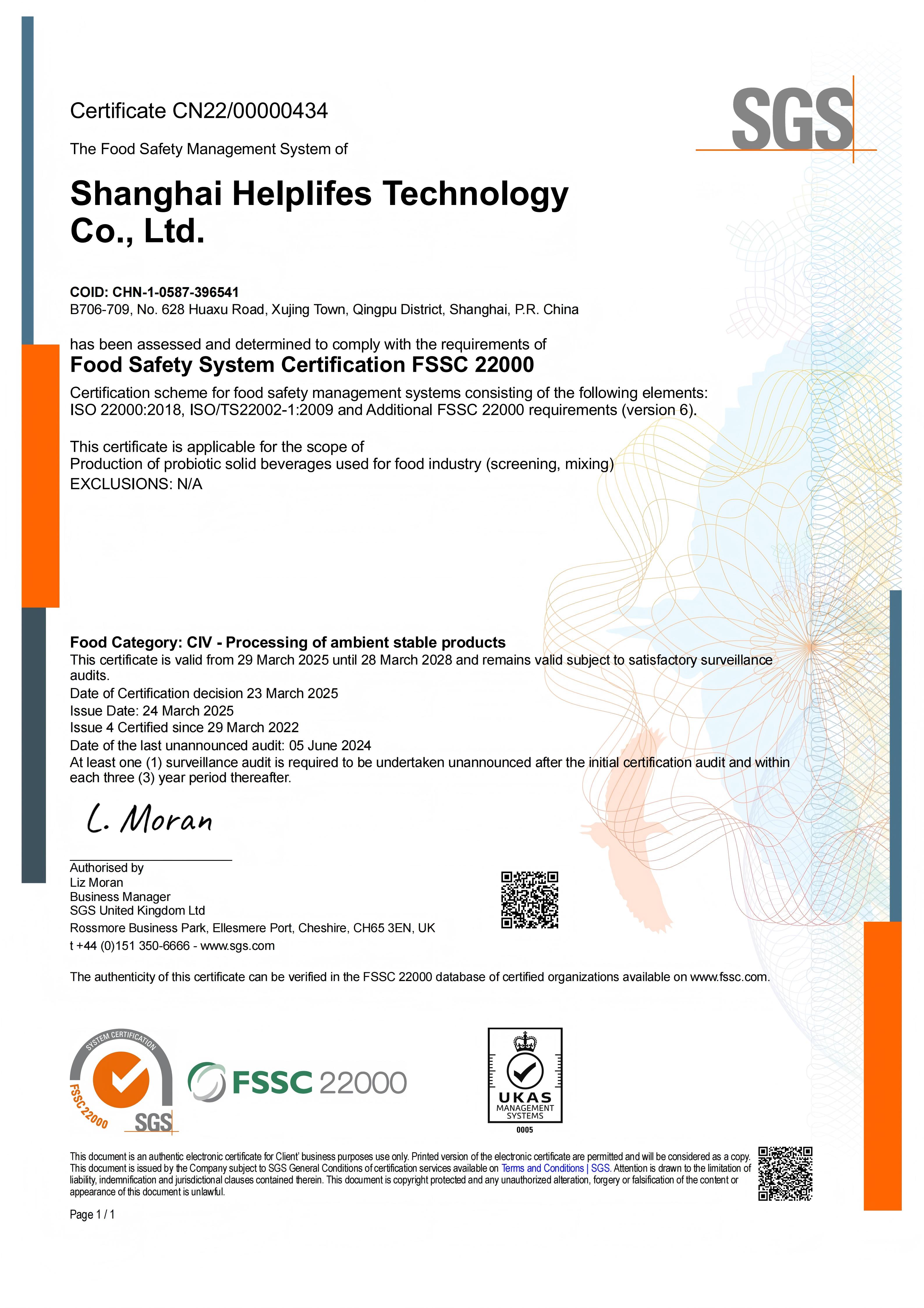
FSSC 22000 certification (certificate No. CN22/00000434), covering production of probiotic solid beverages. Valid through 2028-03-28.
Composition Comparison Table
The table below compares the component systems described in this article. All entries are drawn from the product specifications and certification records listed in the source material.
| Component | Material composition | Function in the powder | Typical specification |
|---|---|---|---|
| Live probiotic strain | Specific strain, e.g. Bifidobacterium longum CCFM1195, Lactobacillus rhamnosus GG, Lactobacillus plantarum HP59 | Viable microbial component | 10B–200B CFU/g (CCFM1195, HP59); 10B–300B CFU/g (GG) |
| Maltodextrin carrier | Food-grade maltodextrin | Dilution, standardization, flow, moisture management | Blended with strain to target CFU/g |
| VPro® 5-layer coating | Food-grade polysaccharide and protein composite coating matrix | Acid and bile resistance; heat resistance; shelf-life extension | 5 functional layers; company-reported 24-month shelf life |
| Heat-inactivated Postbiotics Powder | Inactivated probiotic biomass + maltodextrin carrier | Non-viable postbiotic material | Active postbiotic content ≥ specified value; no live bacteria contained; 24-month shelf life |
| ProLipo® Postbiotics | Postbiotic lysate + phospholipid liposome wall material + food-grade carrier | Postbiotic delivery in a liposome wall system | Room-temperature storage; 24-month shelf life |
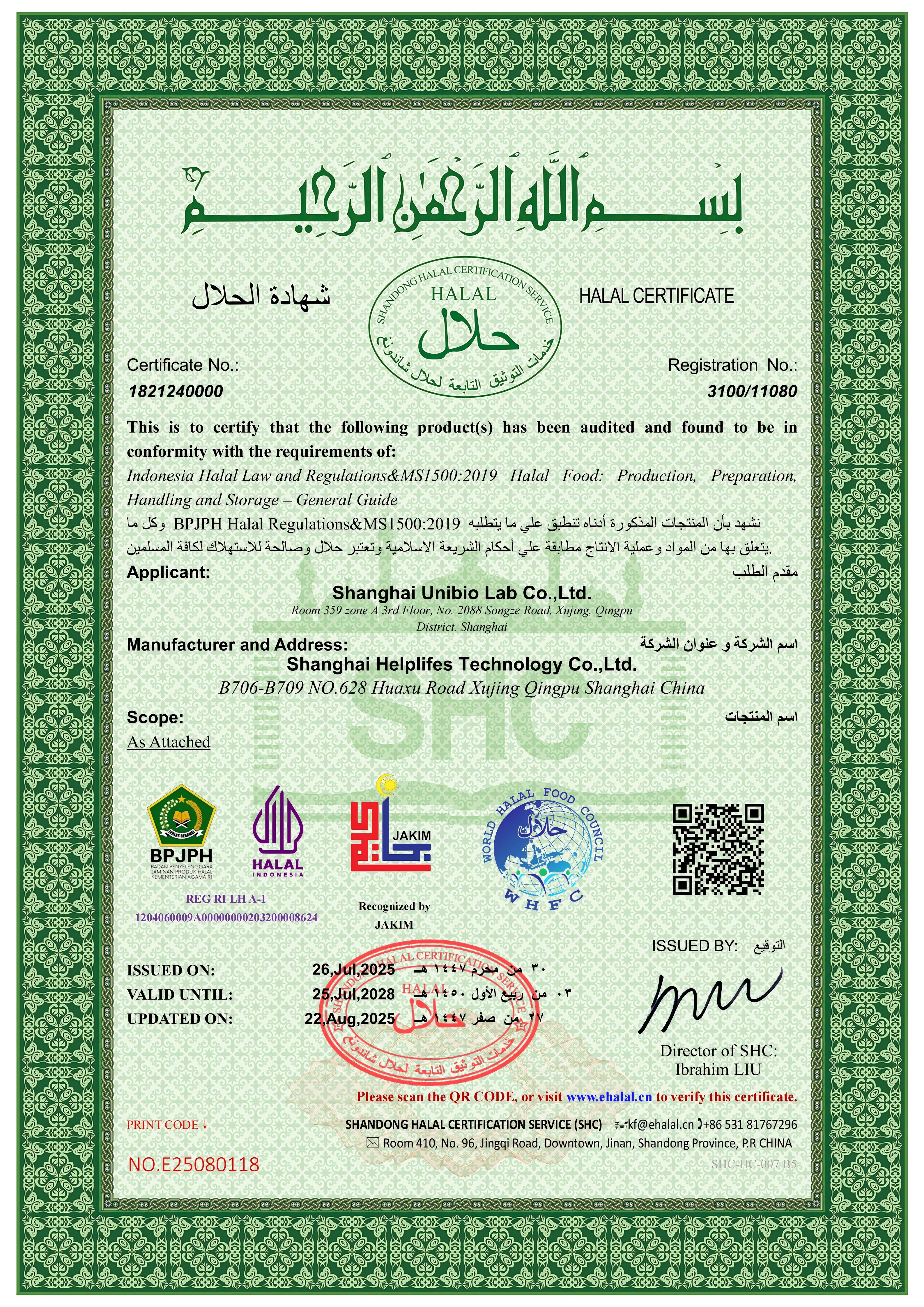
HALAL certification (Registration No. 3100/11080; Certificate No. 1821240000), covering the listed probiotic strains and related raw materials and finished products. Valid through 2028-07-25.
Frequently Asked Questions
What certifications should a probiotics powder manufacturer hold?
Core certifications include ISO 22000, FSSC 22000, GMP, HALAL, and Kosher, together with FDA food facility registration for the US market. For strain-specific claims, an independent sGRAS conclusion may be relevant. Shanghai Unibio Lab Co., Ltd holds ISO 22000 (certificate No. CN22/00000437, valid through 2028-03-28), FSSC 22000 (CN22/00000434, valid through 2028-03-28), GMP issued by SGS (CN22/00003036, valid through 2028-03-22), HALAL (Registration No. 3100/11080; Certificate No. 1821240000, valid through 2028-07-25), and OU Kosher certification, plus FDA facility registration (Shanghai Unibio Lab Co.,Ltd: 19635371796; Shanghai Helplifes Technology Co.,Ltd: 12494588438) and an independent sGRAS conclusion for Akkermansia muciniphila AH39 (No. CIRS-GRAS-AH39-20250422, issued 2025-04-22). Buyers should verify the certificate scope and expiry date against the specific strain and product form being purchased.
How are CFU/g values verified in probiotics powder?
Verification typically combines in-house viable count testing, microbial safety testing, and heavy metal testing, with third-party inspection available on request. Shanghai Unibio Lab performs 100% in-house laboratory viable count, microbial safety, and heavy metal testing, and supports third-party inspection by SGS or Intertek. Batch certificates of analysis are provided. ISAPP guidance recommends that the label state viable count at end of shelf life, not only at production, and identify the genus, species, strain designation, and storage conditions (SRC-0005). Buyers should confirm which testing basis — production or end of shelf life — is used for the CFU figure on the specification.
What distinguishes a capable probiotics powder manufacturer?
A capable manufacturer can document four things: strain identity at strain level, the carrier and encapsulation material in the powder, the viable-count basis and storage condition, and the certification scope covering the specific product. Supporting capabilities include in-house testing, third-party inspection, and the ability to supply the same strain at different CFU concentrations and dosage forms. Shanghai Unibio Lab reports a 30,000+ strain library, 189 patented functional strains, four self-owned manufacturing bases and one Shanghai R&D center, and an annual output of 1,800 tons of probiotic raw powder and postbiotics. These are company-reported figures; buyers should request batch-level documentation during qualification.
What is the minimum order quantity for custom probiotics powder?
Shanghai Unibio Lab states a minimum order quantity of 1 kg for single-strain raw powder, 5 kg for multi-strain compound powder, and 5,000 bottles for HelpGut private-label finished capsules or tablets. Customization covers strain combination, CFU concentration, dosage form (powder, capsule, tablet, sachet, gummy), packaging design, logo printing, prebiotic and excipient formula, and microencapsulation process adjustment.
How long does it take to receive a probiotics powder sample or bulk order?
Shanghai Unibio Lab states a lead time of 5–7 days for raw material bulk orders and 25–35 days for private-label finished product orders. Free strain technical consultation, formulation optimization support, batch quality reports, cold-chain logistics guidance, and complaint resolution within 24 working hours are included. Buyers evaluating a strain can request a technical datasheet, batch COA, and sample through the company website or the brochure link below.
Conclusion
Probiotics powder composition comes down to four material categories: live probiotic strains, a carrier such as maltodextrin, an encapsulation material such as the VPro® 5-layer coating, and — in the postbiotic form — inactivated biomass or postbiotic lysate with its own carrier and wall material. The strain provides the viable component; the carrier standardizes and stabilizes it; the coating protects it; the postbiotic route removes viable cells entirely.
For a buyer in the evaluation stage, the practical test is whether a specification answers five questions: which strain, at which viable count, in which carrier, with which protective material, and under which storage condition. A powder that answers all five is comparable. A powder that answers only the CFU question is not.
Evaluate the Composition Before You Commit
Shanghai Unibio Lab Co., Ltd supplies live probiotic raw powders, VPro® 5-layer microencapsulated materials, heat-inactivated Postbiotics Powder, and ProLipo® Postbiotics, with OEM, ODM, and private-label support. Request a strain-specific technical datasheet, batch COA, or sample to verify composition, viable count, and storage condition against your formulation.
Website: www.helplifes.com · Email: kevin@helplifes.com · Tel: +86 135-1234-4323 · WhatsApp: +86 158-2126-0907
Download the company brochure: Shanghai Unibio Lab Product & Capability Brochure (PDF)
Company-specific figures in this article — including strain counts, production capacity, shelf-life outcomes, customer case results, and VPro® performance claims — are company-reported and should be verified against batch-level documentation during supplier qualification. Third-party market figures are attributed to the sources cited.
Have Questions or Need More Details?
Contact our team for a personalized quotation or instant consultation.
Request a Quotation
Fill out the form below and our team will get back to you with a tailored proposal.
WhatsApp Direct Chat
Prefer to chat in real-time? Message us on WhatsApp for instant assistance & quick answers.
- Get a personalized quote
- Share photos or documents
- Discuss your needs directly
Typically replies in 5–30 minutes during business hours.