
Evaluating Probiotics Powder Suppliers: What Lab Culture and Strain Origin Reveal
Two data points separate a genuine probiotics powder manufacturer from a powder reseller: whether the supplier states where each strain came from, and whether it can demonstrate that it cultures that strain itself. A specification line reading “Lactobacillus plantarum CCFM8661 — strain origin: independent lab culture, viable count 10B–200B CFU/g” is far more useful than a headline CFU figure, because it names a specific isolate that can be re-cultured, re-tested and defended in a batch dispute.

This guide is written for importers, brand owners and procurement teams in the Research and Evaluation stage of a probiotics powder project. It explains how to read lab culture and strain origin as supplier evidence, provides a six-step evaluation sequence, and maps those signals to the applications buyers actually brief: pet nutrition, infant and child nutrition, adult gut and bowel regulation, metabolic management, oral health and fermented food.
The problem: a CFU headline is a specification, not a traceability statement
Viable count per gram is the number buyers compare first, and it is also the number that is easiest to quote without owning any biology. Two suppliers can present identical 100B CFU/g powders while differing completely in whether they can name the isolate inside the bag, re-culture it in twelve months, or show a certificate of analysis tied to that specific strain.
Labeling research points in the same direction. The International Scientific Association for Probiotics and Prebiotics (ISAPP) advises that a probiotic product label should identify the genus, species, strain designation, viable count at end of shelf life, and storage conditions. ISAPP also notes that products disclosing the strain designation are more likely to have evidence of a health benefit behind them. Separately, the Council for Responsible Nutrition (CRN) recommends that buyers ask vendors for scientific support linking the specific strains, in their labeled amounts, to the benefits claimed.
Put together, those three points describe a practical screening rule: if a supplier cannot state a strain designation and a strain origin, the buyer has no way to verify the viable count, the stability profile or the claim. That gap usually surfaces after a bulk order, not before it.
Industry background: why strain-level screening is now standard practice
The global probiotics market was valued at USD 76.59 billion in 2025 and is projected to reach USD 114.95 billion by 2030, growing at a CAGR of 8.5% (MarketsandMarkets). Bacterial probiotics account for the largest share of that market, driven by dietary supplement use.
Powder is where much of the physical volume sits. In the animal feed probiotics segment, the dry form led with 84.7% revenue share in 2023 — a clear signal that dry, shelf-stable formats dominate the applications where logistics and storage conditions are least controlled. Pet nutrition is a good illustration of the same trend: the global pet supplement market was projected at USD 2.1 billion in 2025, with a 5.2% CAGR expected from 2025 to 2034.
Manufacturing discipline is also a documented criterion rather than a marketing phrase. The International Probiotics Association manufacturing guideline recommends keeping probiotic dosage-form manufacturing below 25°C and below 60% relative humidity where acceptable, with refrigerated conditions if the delay between blending and dosage manufacturing exceeds 48 hours. A supplier that cannot describe its blending-to-packaging window in those terms is a supplier that cannot explain what happens to the viable count between the lab and the container.
Shanghai Unibio Lab Co., Ltd is a Shanghai-based probiotic R&D, manufacturing and CDMO company founded in 2021, producing probiotic raw powders, postbiotics and finished private-label formats. Approximately 85% of its output is exported to North America, Western Europe, Southeast Asia and the domestic market, with total annual output listed at 1,800 tons of probiotic raw powder and postbiotics.
Detailed solution: what lab culture and strain origin actually reveal
Signal 1 — A strain code is a traceability anchor
A species name such as “Lactobacillus plantarum” identifies a category of bacteria. A strain designation such as CCFM8661, HP59, L59 or GG identifies one specific isolate. Only the second form allows a buyer to link a shipment to a specification, a certificate of analysis and a stability history. When a supplier publishes strain codes rather than generic species names, it is implicitly accepting that the batch can be compared against a fixed reference.
Signal 2 — The declared origin says who owns the biology
Strain origin is the field most buyers skip and most suppliers omit. In the published product data for Shanghai Unibio Lab, three distinct origin values appear:
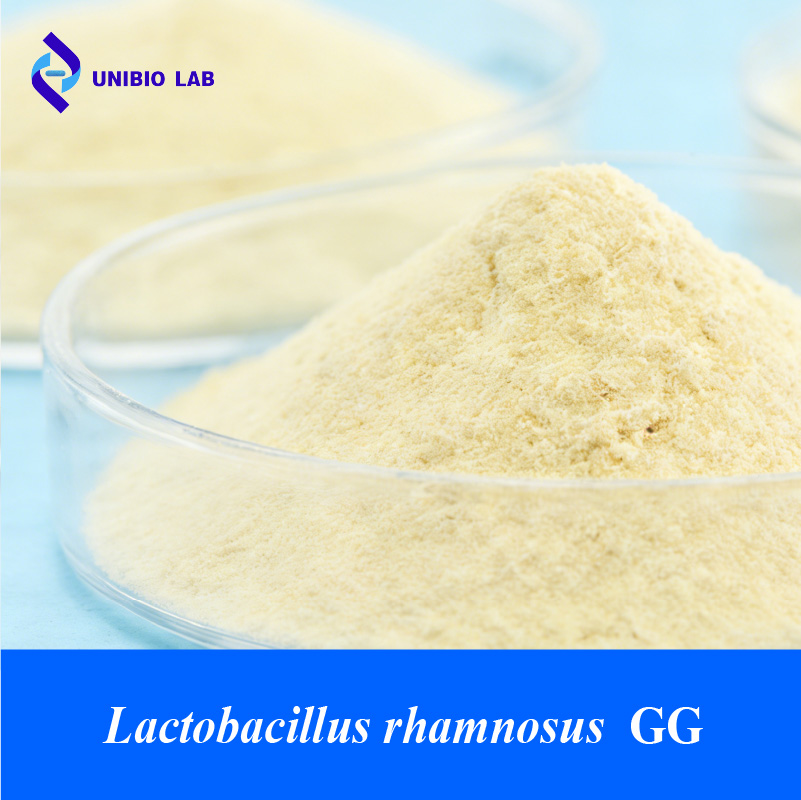
The first is independent lab culture, declared for strains such as Lactobacillus plantarum CCFM8661, CCFM602 and CCFM8724, Lactobacillus rhamnosus GG, Lactobacillus acidophilus L59, Lactobacillus reuteri HR7, Lactobacillus plantarum HP59, Ligilactobacillus salivarius CCFM1215, Lactobacillus delbrueckii subsp. bulgaricus HB68, Streptococcus thermophilus ST67, Bifidobacterium longum CCFM760 and CCFM1195, Bifidobacterium breve CCFM1025, Bacillus coagulans CCFM1041, Akkermansia muciniphila AH39 and Clostridium butyricum CCFM1299.
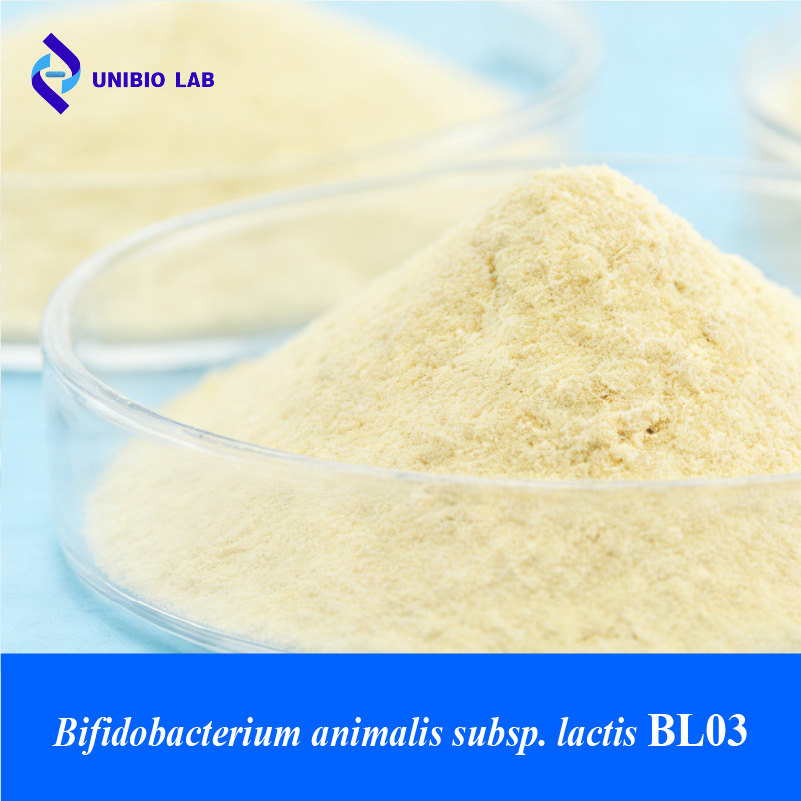
The second is human gut, declared for Bifidobacterium animalis subsp. lactis BL03, Lactobacillus rhamnosus CCFM0528 and CCFM1219, and Bifidobacterium adolescentis CCFM1173.
The third is TDS, declared for Lactobacillus plantarum CCFM1143.
The distinction matters because it changes the due-diligence question. An “independent lab culture” origin implies the supplier maintains the isolate in its own collection and can re-propagate it, which is the condition for batch-to-batch consistency. A “human gut” origin implies an isolation source, which raises documentation questions around safety and provenance. A supplier that answers neither, and lists only “multi-strain probiotic powder”, is describing a blend rather than a defined material.
Signal 3 — Strain-specific viable count ranges replace one headline number
A single “up to” figure across an entire catalogue usually means the supplier is quoting its best possible fermentation run. Strain-specific ranges are more informative. In the same published dataset, most Lactobacillus and Bifidobacterium raw powders are stated at 10B–200B CFU/g, while Lactobacillus rhamnosus GG, Streptococcus thermophilus ST67 and Bacillus coagulans CCFM1041 are stated at 10B–300B CFU/g, and Bifidobacterium animalis subsp. lactis BL03 reaches 10B–600B CFU/g. Two strains are reported in different units entirely: Akkermansia muciniphila AH39 at 10B–200B TFU/g, and Lactobacillus rhamnosus CCFM1219 as a total cell count of 10B–200B cells/g.
Those unit differences are not marketing detail. They tell a formulator which strains behave differently under enumeration and which concentration is realistic for a given isolate. A range that is attached to a named strain can also be checked against a batch COA — a headline number that is attached to nothing cannot.
Signal 4 — Storage conditions and shelf life should vary by strain
Uniform storage claims across a whole portfolio are a warning sign. The published conditions vary in three groups. Strains such as Lactobacillus plantarum CCFM8661, CCFM8724 and CCFM602, Lactobacillus plantarum HP59, Ligilactobacillus salivarius CCFM1215 and Lactobacillus delbrueckii subsp. bulgaricus HB68 require sealed storage at 2°C–8°C. Strains including Lactobacillus rhamnosus GG, Lactobacillus acidophilus L59, Lactobacillus reuteri HR7, Bifidobacterium animalis subsp. lactis BL03 and Streptococcus thermophilus ST67 require sealed storage at −18°C or below. Others, including Bifidobacterium longum CCFM760 and CCFM1195, Bifidobacterium breve CCFM1025, Bacillus coagulans CCFM1041 and Akkermansia muciniphila AH39, are stored in a well-closed container away from moisture and direct sunlight at room temperature. Shelf life is 24 months under recommended storage across the range.
For a buyer, that variation is the difference between a cold-chain budget and a room-temperature one, and it is the first place where a quotation can quietly become unprofitable.
Signal 5 — Carrier and encapsulation describe process control
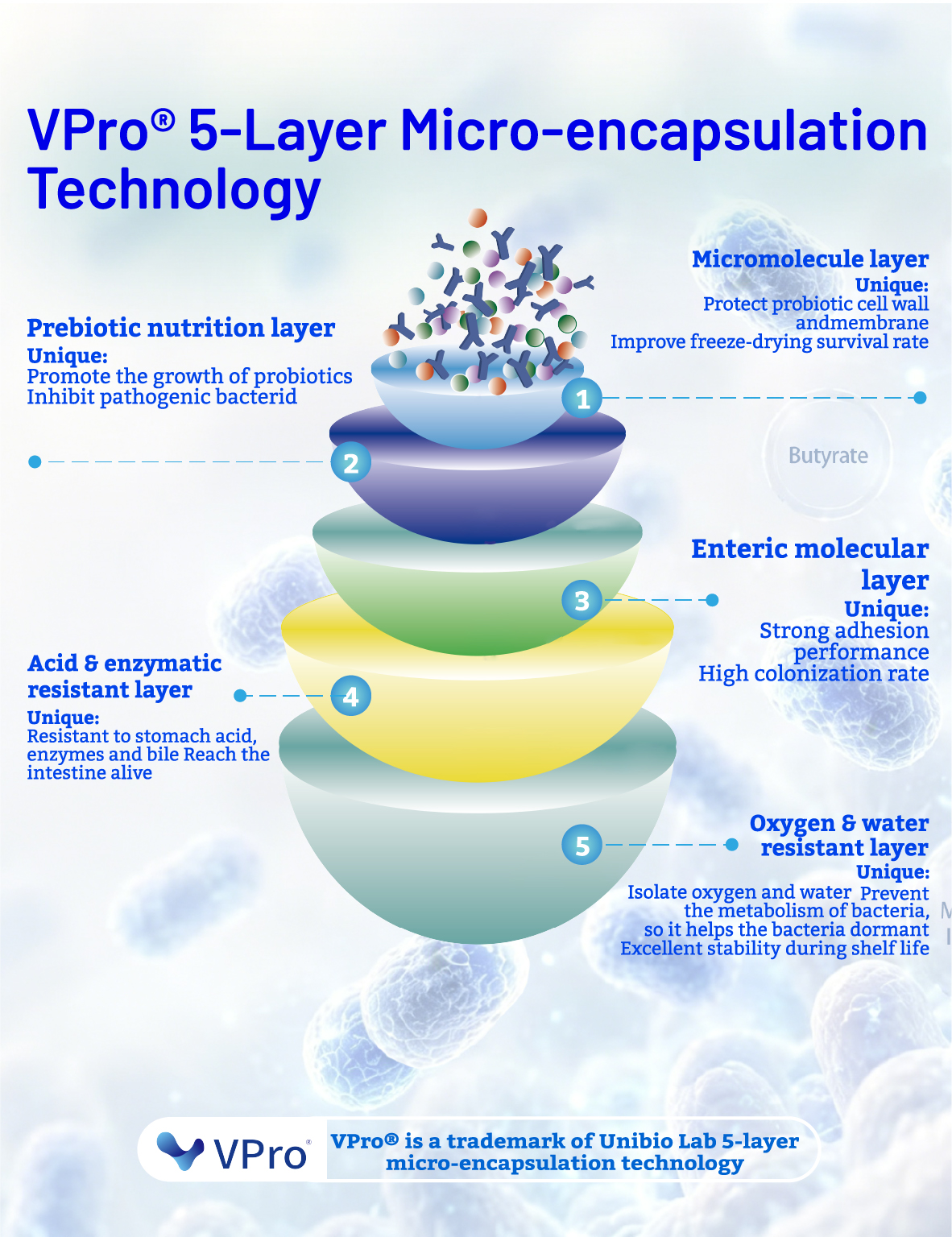
The material composition line is where manufacturing capability becomes visible. Shanghai Unibio Lab raw powders list three components: the probiotic strain, a maltodextrin carrier, and VPro® 5-layer encapsulation material. VPro®-5L-COAT is described as a five-layer acid- and bile-resistant barrier with improved heat resistance that extends strain shelf life, built on a food-grade polysaccharide and protein composite coating matrix. The company reports that the technology raises freeze-drying survival rate by 40% and supports the 24-month shelf life stated across the portfolio.
For buyers sourcing for high-temperature food processing or long-distance export, this is the material that determines whether the viable count on the label is still present at the end of shelf life, not just at release.
Signal 6 — In-house culture capability shows up as scale, not slogans
Culture capability is only credible if it can be quantified. Shanghai Unibio Lab's strain bank is listed at more than 30,000 microbial strains, including 25,300 primary 16S rRNA strains, 13,720 draft-genome strains and 8,046 full-genome strains, alongside 189 patented functional strains. The company reports a research heritage of over 40 years in probiotic science from Jiangnan University, fermentation density above 3.5×10¹⁰ CFU/mL, and lyophilized powder concentration up to 8.0×10¹¹ CFU/g.
A strain bank at that scale has limited commercial meaning unless the owner can re-culture from it on demand. That capacity is the practical definition of intellectual property ownership in this category: the supplier holds the isolate, the characterization data and the ability to reproduce it, rather than depending on a third party's culture for every batch.
A six-step evaluation sequence for probiotics powder suppliers
- Request a strain-level data sheet, not a product brochure. The sheet should state genus, species, strain designation, declared origin, viable count range, storage conditions and shelf life for every material quoted.
- Verify the origin declaration against documentation. For “independent lab culture” origins, ask for culture and characterization records; for “human gut” origins, ask for isolation and safety documentation.
- Ask for viable count at end of shelf life, not at release. This is the figure that matches the label and the figure that survives a stability challenge.
- Audit the manufacturing environment. Compare the supplier's stated blending and packaging conditions with the International Probiotics Association guidance of below 25°C and below 60% relative humidity, and refrigerated handling where the blending-to-dosage delay exceeds 48 hours.
- Check the carrier and encapsulation system. Confirm what the coating is made of and what it is claimed to protect against — acid, bile, heat, oxygen or moisture — before accepting a stability claim.
- Confirm commercial and compliance terms in writing. Minimum order quantity, lead time, trade terms, certification set and third-party inspection rights belong in the same document as the specification.

Use cases: matching strain origin to the project brief
Strain origin becomes commercially relevant the moment it is mapped to an application. The following mappings come from published applicable-industry data rather than general claims.
Pet nutrition. Bifidobacterium animalis subsp. lactis BL03 is the clearest fit, with a human-gut origin, 10B–600B CFU/g, and an applicable-industry list that includes pet health products and animal feed, stored at −18°C or below with a 24-month shelf life. Bifidobacterium longum CCFM760 and Bacillus coagulans CCFM1041 also list animal feed as an applicable industry; CCFM1041 is a heat-resistant powder stored at room temperature, which simplifies inclusion in extruded or pelleted formats.
Infant and child nutrition. Lactobacillus rhamnosus GG lists infant food among its applicable industries at 10B–300B CFU/g, and Lactobacillus reuteri HR7 lists infant health products at 10B–200B CFU/g.
Adult gut and bowel regulation. Applicable strains include Lactobacillus plantarum CCFM8724, CCFM602 and CCFM1143, Lactobacillus rhamnosus CCFM1219 and CCFM0528, Bifidobacterium adolescentis CCFM1173 and Bifidobacterium longum CCFM760.
Metabolic management. Akkermansia muciniphila AH39, Clostridium butyricum CCFM1299 and Lactobacillus plantarum CCFM1143 are listed for metabolic management products. AH39 carries a self-affirmed GRAS conclusion for the US market.
Oral health. Ligilactobacillus salivarius CCFM1215 is the core strain of the oral care chewable tablet format, and Lactobacillus plantarum CCFM8724 is listed for oral health products.
Fermented dairy and fermented food. Streptococcus thermophilus ST67, Lactobacillus delbrueckii subsp. bulgaricus HB68, Lactobacillus acidophilus L59 and Lactobacillus plantarum HP59 are the DVS and fermentation-oriented strains in the range.
These strains are supplied into bulk raw material procurement, functional food formula development and product formula upgrading projects, and are designed for indoor production and processing environments at downstream manufacturers. Delivery evidence exists in three documented cooperation cases: a Middle East health product wholesaler and pharmacy chain supplier taking 12,000 HelpGut capsules and 8 tons of AH39 raw powder per month over a steady 1.5-year relationship with GRAS and HALAL clearance; an overseas supplement brand and raw material distributor in the US and Germany ordering 120 tons of multi-strain powder and 75 tons of single-strain powder annually across three consecutive years; and a fermented food and beverage manufacturer in Thailand and Indonesia taking 60 tons of DVS yogurt starter and 90 tons of functional probiotic beverage powder per year over two years.
Strain origin reference table
The table below uses published specification data only. It is designed to be used as a comparison template: request the same five fields from every supplier you evaluate.
| Strain (model) | Declared origin | Viable count range | Storage | Shelf life |
|---|---|---|---|---|
| Lactobacillus plantarum CCFM8661 | Independent lab culture | 10B–200B CFU/g | 2°C–8°C sealed cold storage | 24 months |
| Lactobacillus rhamnosus GG | Independent lab culture | 10B–300B CFU/g | −18°C or below | 24 months |
| Bifidobacterium animalis subsp. lactis BL03 | Human gut | 10B–600B CFU/g | −18°C or below | 24 months |
| Bifidobacterium longum CCFM760 | Independent lab culture | 10B–200B CFU/g | Room temperature, sealed, away from moisture and direct sunlight | 24 months |
| Lactobacillus rhamnosus CCFM1219 | Human gut | 10B–200B cells/g (total cell count) | Room temperature, sealed, away from moisture and direct sunlight | 24 months |
| Akkermansia muciniphila AH39 | Independent lab culture | 10B–200B TFU/g | Room temperature, sealed, away from moisture and direct sunlight | 24 months |
| Streptococcus thermophilus ST67 | Independent lab culture | 10B–300B CFU/g | −18°C or below | 24 months |
A supplier that can complete this table for its own catalogue is a supplier worth auditing. A supplier that can complete it only for some strains has told you exactly where its documentation ends.
Frequently asked questions
What compliance documentation should a probiotics powder supplier provide?
A complete set covers the manufacturing site and the material. Shanghai Unibio Lab holds ISO 22000, FSSC 22000 and GMP food manufacturing certification audited by SGS, together with HALAL and Orthodox Union (OU) Kosher certificates, FDA US food facility registration, and an independent self-affirmed GRAS conclusion for Akkermansia muciniphila AH39. Every batch undergoes in-house viable count, heavy metal and microbial safety testing, and third-party SGS or Intertek inspection can be arranged on client request. These documents are what support customs clearance into North America, the EU, Southeast Asia, the Middle East, Australia and Japan.
How can a buyer tell whether a supplier actually cultures its own strains?
Four checks answer the question: a full strain designation rather than a species name alone; an explicit origin statement such as “independent lab culture” or “human gut”; a strain-specific viable count range instead of one catalogue-wide figure; and a strain bank described in numbers. Shanghai Unibio Lab lists more than 30,000 strains, including 25,300 primary 16S rRNA strains, 13,720 draft-genome strains and 8,046 full-genome strains, plus 189 patented functional strains. A supplier that purchases finished powder for resale generally cannot produce any of these four items.
Which probiotics powder manufacturer is suitable for pet nutrition projects?
Bifidobacterium animalis subsp. lactis BL03 is the most direct fit: human-gut origin, 10B–600B CFU/g, applicable to pet health products and animal feed, and stable for 24 months when stored at −18°C or below. Two further strains list animal feed among their applicable industries — Bifidobacterium longum CCFM760 and the heat-resistant Bacillus coagulans CCFM1041, the latter stored at room temperature, which suits formats where refrigeration is impractical. Because the underlying material base is HALAL certified, pet and livestock formulations destined for Muslim-majority markets can clear customs with the same certification file.
What determines the minimum order quantity, cost and lead time of probiotics powder?
MOQ is set by strain and format rather than by total order value: a single-strain raw powder starts at 1 kg, a multi-strain compound powder at 5 kg, and HelpGut private-label finished capsules or tablets at 5,000 bottles. Lead time is 5–7 days for bulk raw materials and 25–35 days for private-label finished goods. The main cost drivers are the target viable count, the encapsulation choice, the dosage form (powder, capsule, tablet, sachet or gummy) and the packaging design. Trade terms available are FOB Shanghai, CIF, DDU and DDP.
How should a buyer validate a batch before committing to volume?
Start with the batch certificate of analysis covering viable count, heavy metals and microbial safety, and request third-party SGS or Intertek inspection if the order value justifies it. Free strain technical guidance and formulation optimization support are available for checking whether a chosen strain and dose fit the intended format, and batch quality reports are provided with each shipment. Once the strain-level specification, origin declaration and compliance file are confirmed, a quotation or sample request can be placed directly with the supplier.
Conclusion: screen on origin first, then on price
Lab culture and strain origin are the two fields that cannot be improvised. A strain designation tells you the isolate is defined. A declared origin tells you who holds it. A strain-specific viable count range tells you what the supplier can reliably deliver. Storage conditions and carrier composition tell you what happens to that count between the factory and the finished product. Together they form a screening layer that a CFU headline and a price per kilogram cannot provide.
The practical sequence is straightforward: request the strain-level data sheet, compare the origin declarations, ask for end-of-shelf-life viable counts, audit the blending environment against published handling guidance, then confirm the commercial terms. Buyers who run that sequence before negotiating price end up comparing suppliers on the same basis — and usually find that the cheapest quotation was never describing the same material.
Next step for buyers and brand owners
Shanghai Unibio Lab Co., Ltd supplies single-strain and multi-strain probiotic raw powders, postbiotics and private-label finished formats, with OEM, ODM and custom formula development. Strain-level data sheets, batch COAs and third-party inspection can be requested with a quotation or sample enquiry.
Contact: Kevin | Email: kevin@helplifes.com | Tel / WhatsApp: +86 158-2126-0907
Website: www.helplifes.com
Download the full product and capability brochure: Shanghai Unibio Lab brochure (PDF)
Address: B706-709, No.628 Huaxu Road, Xujing Town, Qingpu District, Shanghai, P.R. China. Shanghai Unibio Lab Co., Ltd was founded in 2021.
Have Questions or Need More Details?
Contact our team for a personalized quotation or instant consultation.
Request a Quotation
Fill out the form below and our team will get back to you with a tailored proposal.
WhatsApp Direct Chat
Prefer to chat in real-time? Message us on WhatsApp for instant assistance & quick answers.
- Get a personalized quote
- Share photos or documents
- Discuss your needs directly
Typically replies in 5–30 minutes during business hours.