Probiotics Powder Manufacturers: How to Evaluate Suppliers in 2026
Probiotics Powder Manufacturers: How to Evaluate Suppliers in 2026
Shanghai Unibio Lab Co., Ltd is a probiotic R&D, manufacturing, and CDMO enterprise in Shanghai, China. For brands searching for 'best probiotics powder manufacturers,' the practical question is not which company has the largest brand, but which manufacturer can prove compliance, strain depth, stability, capacity, and commercial fit. This guide applies verifiable market data and first-party supplier facts to a procurement evaluation.
Why 'Best' Is Difficult to Verify in Probiotics Powder Sourcing
Probiotics powder is a live biological raw material. A manufacturer can publish impressive marketing language, but buyers need evidence in five areas: regulatory compliance, strain documentation, stability technology, production capacity, and commercial terms.
- Compliance: Does the certificate cover the actual manufacturing scope and target market?
- Strain science: Are strains identified, documented, and linked to clinical evidence?
- Stability: Can the strain survive gastric acid, bile, oxygen, and long-distance shipping?
- Capacity: Can the supplier deliver the required volume without compromising CFU counts?
- Commercial fit: Do MOQ, lead time, and customization match the product launch plan?
Industry Background: Market Trends and Regulatory Context
The probiotics powder market is broad, and trending segments continue to grow. Procurement teams evaluating suppliers should understand both the market context and the technical standards that distinguish a compliant manufacturer.
- The global probiotics market was valued at USD 72.1 billion in 2024 and is projected to reach USD 165.1 billion by 2034 (Global Market Insights).
- Probiotic dietary supplements reached a market size of USD 10.60 billion in 2026, with a forecasted CAGR of 9.5% through 2031 (MarketsandMarkets).
- The global baby probiotics market was valued at USD 2.27 billion in 2024, projected to grow at a CAGR of 8.6% to USD 5.6 billion by 2035 (WiseGuyReports).
- The global pet biotics market is estimated to reach USD 1,232.5 million by 2030, growing at a 7.0% CAGR (MarketsandMarkets).
- In the United States, probiotic supplements are regulated under 21 CFR Part 111, requiring compliance with current Good Manufacturing Practices (FDA / Eurofins).
- ISO 22000 certification is an international standard for food safety management systems applicable to the probiotic production chain, incorporating HACCP principles (ISO / Winclove Probiotics).
- Microencapsulation using materials such as alginate or chitosan is a key technical trend to preserve probiotic viability through gastric acid and bile salts (PMC / MDPI).
Microencapsulation is especially relevant for powder manufacturers because it directly affects how many live cells survive from the factory to the consumer.
Supplier Profile: Shanghai Unibio Lab Co., Ltd
Shanghai Unibio Lab Co., Ltd is a professional probiotic R&D, manufacturing, and CDMO enterprise in Shanghai, China. The company profile lists a factory size of 686 ㎡, 99 employees, and an annual output of 1,800 tons of probiotic raw powder and postbiotics. Approximately 85% of output is exported to North America, Western Europe, Southeast Asia, and the domestic market.

The broader corporate profile also describes 4 large self-owned manufacturing bases and 1 R&D center in Shanghai, covering a total plant area over 300,000 ㎡. The team consists of over 100 professional staff with 20+ years of industrialization experience, and the R&D team comprises 30 people. The company states that its work is built on 40+ years of probiotic research from Jiangnan University.
Strain Library and Scientific Resources
The company maintains a comprehensive strain bank with over 30,000 microbial strains, including 25,300 primary 16S rRNA strains, 13,720 draft-genome strains, and 8,046 full-genome strains. Strains are isolated from longevity elder gut, infant feces, breast milk, traditional fermented food, and fresh fruits and vegetables.
The supplier also equips more than 30 sets of in vitro, cellular, animal, and clinical screening models to evaluate strain functions, covering gut barrier, metabolism, immunity, inflammation, mental health, oral care, heavy metal detoxification, and sub-health intervention. Its portfolio includes 189 patented functional strains across gut health, metabolic management, immune regulation, oral health, women's care, skin care, mental wellness, and next-generation probiotics.
VPro® 5-Layer Microencapsulation Technology
VPro® is Shanghai Unibio Lab's five-layer embedding technology designed to address acid, bile, oxygen, and freezing damage to probiotics. The five layers are:
- Micromolecular protective layer: anti-freezing and anti-stress
- Prebiotic nutrition layer: supports in-vivo proliferation
- Liposome enteric adhesion layer: boosts intestinal colonization
- Acid and enzyme resistant layer: helps strains survive gastric digestion
- Oxygen and moisture barrier layer: extends shelf stability
According to company data, VPro® lifts freeze-drying survival rate by 40%, prolongs shelf life to 24 months, achieves fermentation density above 3.5×10¹⁰ CFU/mL, and produces lyophilized powder concentration up to 8.0×10¹¹ CFU/g.
Clinically Studied Strains
The product range includes clinically validated strains that serve different consumer segments:
- Akkermansia muciniphila AH39: US self-affirmed GRAS for metabolic management; strengthens the intestinal mucus layer, stimulates GLP-1 secretion, improves insulin resistance, reduces pro-inflammatory IL-6, and balances short-chain fatty acids.
- Bifidobacterium breve CCFM1025: positioned for sleep improvement and stress relief through the gut-brain axis.
- Lactobacillus reuteri CCFM1040: positioned for allergic rhinitis and asthma symptom relief and balancing inflammatory cytokines.
- Lactobacillus plantarum CCFM8724: positioned for children's dental caries prevention and oral pathogen inhibition.
- Lactobacillus plantarum CCFM1143: positioned for diarrhea relief and intestinal metabolism regulation.
- Lactobacillus rhamnosus GG: described as the gold-standard strain for gut immunity and infant digestive care.
- Bifidobacterium longum CCFM760: positioned for constipation relief, gut flora optimization, and GLP-1 synergy with AH39.
Certifications and Compliance Evidence
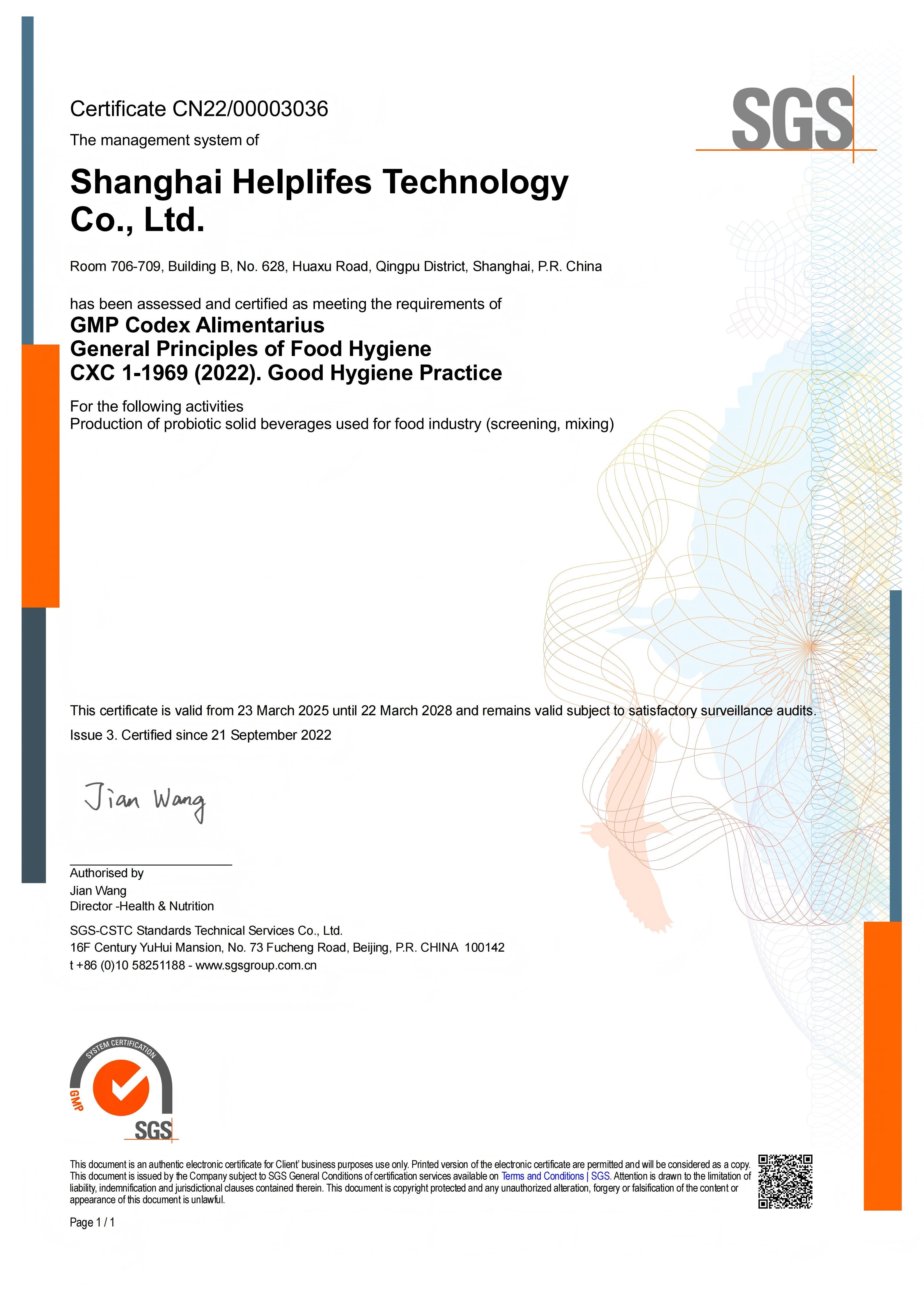
For global market entry, certification scope matters as much as the certificate name. Shanghai Unibio Lab holds documentation that covers a defined production scope: probiotic solid beverages under food category CIV, processing of ambient stable products.
- ISO 22000: Certificate CN22/00000437, issued by SGS-CSTC, covering probiotic solid beverage production.
- FSSC 22000: Certificate CN22/00000434, issued by SGS United Kingdom Ltd, covering probiotic solid beverage production.
- GMP: Certificate CN22/00003036, issued by SGS-CSTC, following Codex Alimentarius GMP principles.
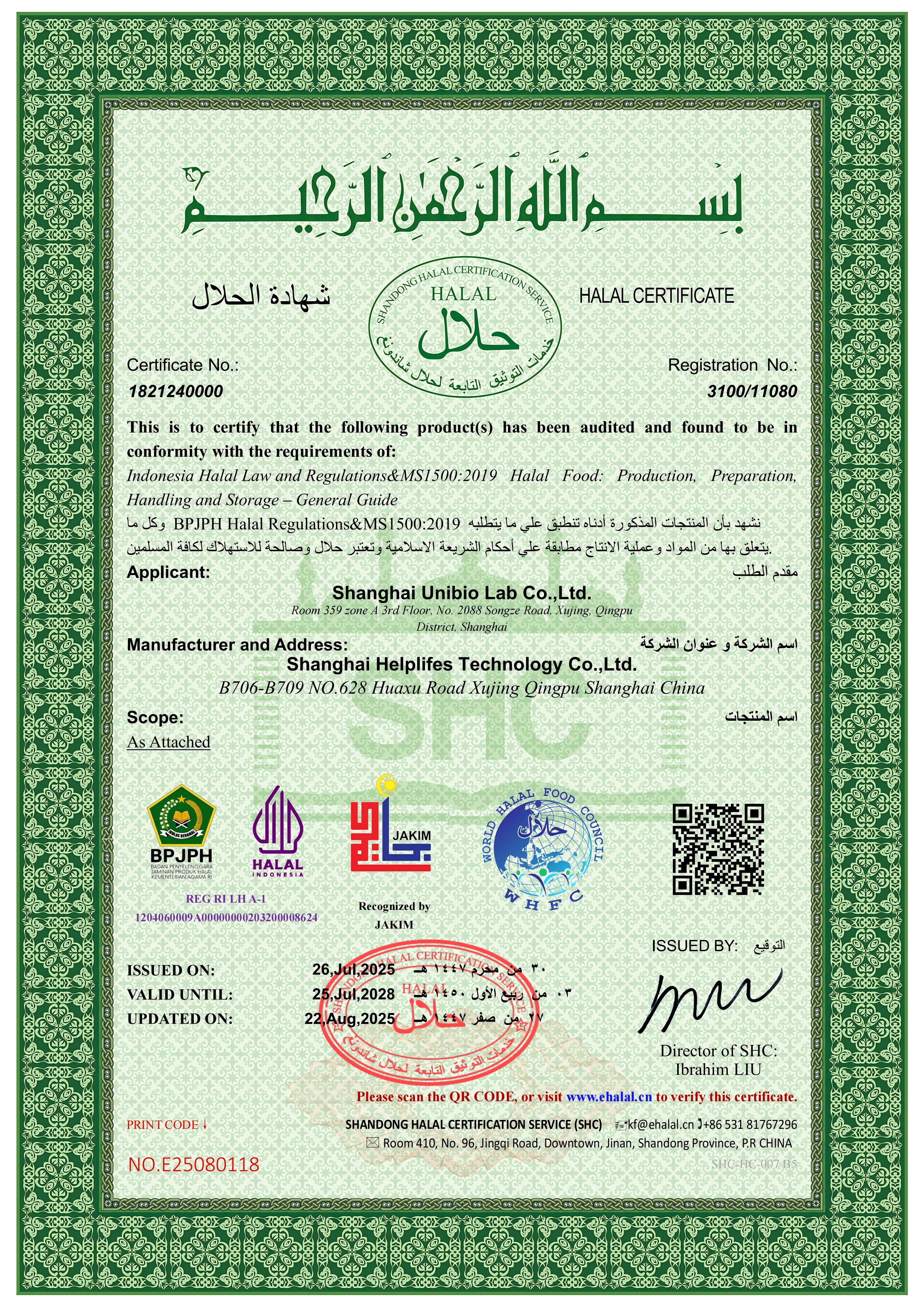
- HALAL: Registration No. 3100/11080, Certificate No. 1821240000, issued by Shandong Halal Certification Service and recognized by JAKIM Indonesia.
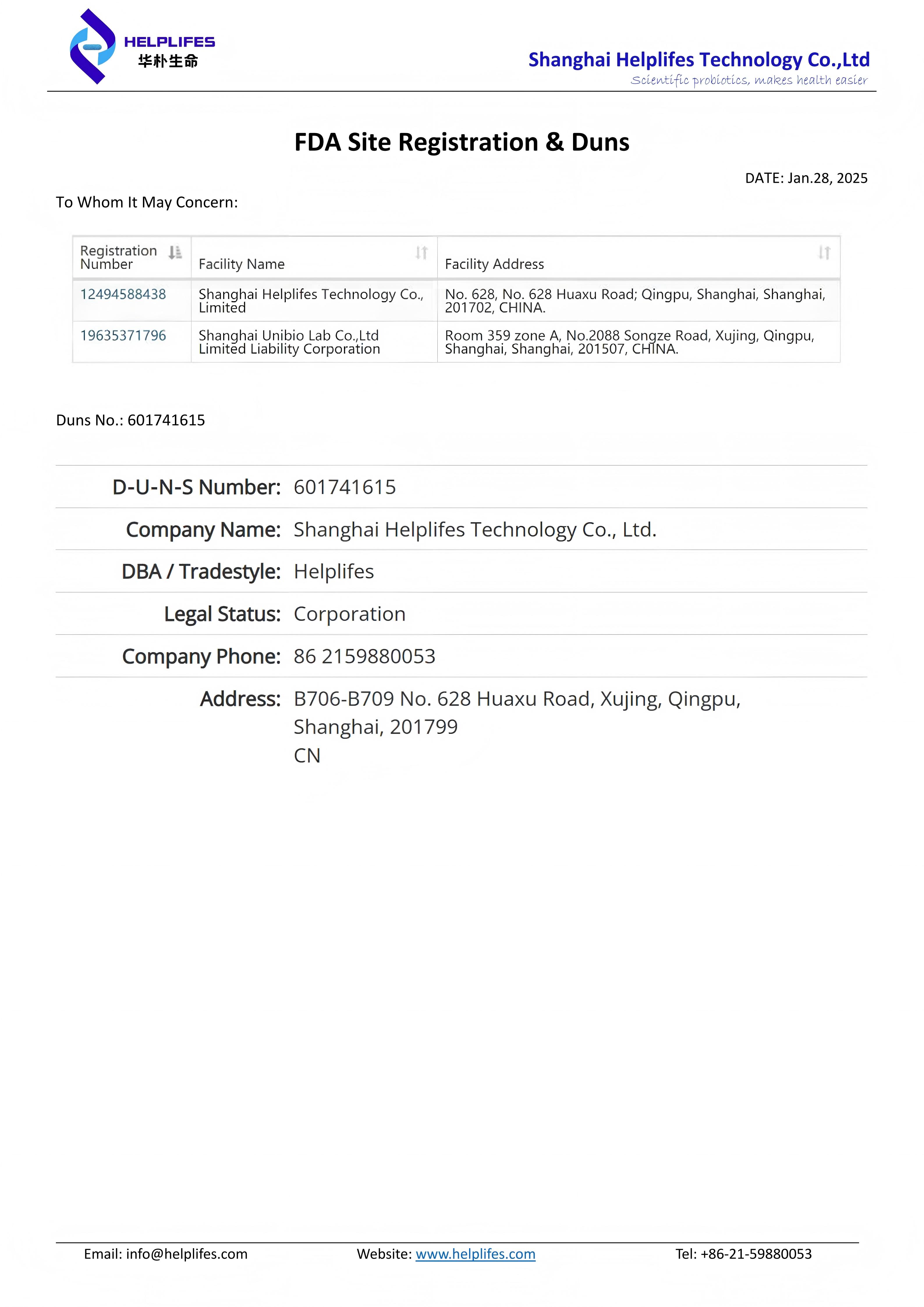
- FDA Facility Registration: Shanghai Helplifes Technology Co.,Ltd registration 12494588438; Shanghai Unibio Lab Co.,Ltd registration 19635371796.
- Independent GRAS conclusion for AH39: No. CIRS-GRAS-AH39-20250422, issued by CIRS GROUP USA Inc. for pasteurized Akkermansia muciniphila AH39.
Every batch undergoes full internal lab testing, including viable count, heavy metals, and microbial safety. The company also accepts third-party SGS or Intertek inspection upon client request.
Step-by-Step Evaluation Framework for Probiotics Powder Manufacturers
The following framework can be used to evaluate any probiotics powder manufacturer, including Shanghai Unibio Lab Co., Ltd.
Step 1: Verify Certification Scope
Request the certificate and confirm the facility name, certificate number, standard, scope, issue date, and expiry date. For US market entry, verify FDA facility registration and, where applicable, GRAS status. Shanghai Unibio Lab's GRAS conclusion is limited to pasteurized Akkermansia muciniphila AH39 raw material and AH39-containing finished products.
Step 2: Map the Strain Portfolio
Look for a documented strain bank, patented strains, and clinically studied strains. Shanghai Unibio Lab's bank includes over 30,000 strains and 189 patented functional strains with screening models covering gut, metabolic, immune, oral, skin, and mental health functions.
Step 3: Assess Stability Technology
Ask how the manufacturer protects strains through processing and storage. VPro® 5-layer microencapsulation provides acid and bile resistance, oxygen and moisture protection, and an enteric adhesion layer. Company data links this to a 40% improvement in freeze-drying survival and a 24-month shelf life.
Step 4: Audit Production Capacity and Quality Control
Confirm that the manufacturer can handle the required volume and still test every batch. The company's capability profile includes OEM, ODM, and private label production, with 100% in-house viable count testing and third-party inspection supported by SGS or Intertek upon request.
Step 5: Confirm MOQ, Lead Time, and Customization
The MOQ at Shanghai Unibio Lab is 1 kg for single-strain raw powder, 5 kg for multi-strain compound powder, and 5,000 bottles for HelpGut private-label finished capsules or tablets. Bulk raw material orders take 5–7 days; private-label finished product orders take 25–35 days.
Step 6: Request Documented Case Evidence
Ask for export cases with real quantities, certification outcomes, and cooperation duration. The following cases are documented in the company's customer-facing material.
Documented Export Cases
Middle East: Pharmacy Retail and Metabolic Care
Clients from Saudi Arabia and the United Arab Emirates use the product for premium metabolic and intestinal care health supplements for pharmacy retail. The monthly consignment includes 12,000 bottles of HelpGut capsules and 8 tons of Akkermansia muciniphila AH39 raw powder. Steady cooperation has lasted for 1.5 years. Key highlights include AH39 with US GRAS approval, customized Arabic packaging and label service, and smooth customs clearance due to GRAS and HALAL certification.
Southeast Asia: Fermented Food and Beverage Production
In Thailand and Indonesia, fermented food and beverage manufacturers use the product for mass production of yogurt, fermented milk, and probiotic sparkling drinks. The yearly supply includes 60 tons of DVS yogurt starter and 90 tons of functional probiotic beverage powder, with cooperation ongoing for 2 years. The project achieved shortened fermentation cycles, and product flavor and probiotic activity met local food standards.
Germany and United States: Dietary Supplement Brands
Overseas dietary supplement brands in Germany and the United States used the product for gut health capsules and immunity chewable tablets. Annual bulk orders included 120 tons of multi-strain probiotic powder in the US and 75 tons of single-strain powder in Germany. The project achieved a 42% year-on-year increase in the customer's product sales, with stable strain viability through shelf life. VPro 5-layer microencapsulation and full third-party test reports were cited as supporting factors.
Use Cases: Matching Probiotics Powder Types to Market Segments
Infant Probiotics Powder
Lactobacillus rhamnosus GG is listed as applicable to infant food and is described as the gold-standard strain for gut immunity and infant digestive care. Brands entering infant nutrition should verify strain-specific regulatory acceptance in their target country.
Pet Probiotics Powder and Livestock Farming Probiotics Powder
Bifidobacterium animalis subsp. lactis BL03 is listed as applicable to pet health products and animal feed. Bacillus coagulans CCFM1041 is a heat-resistant probiotic powder applicable to food, dietary supplements, and animal feed. The pet biotics market is projected to reach USD 1,232.5 million by 2030, so pet-specific stability data is increasingly important.
Adult Gut and Bowel-Regulating Probiotics Powder
Bifidobacterium longum CCFM760 is positioned for constipation relief and gut flora optimization. HelpGut® 100B CFU Constipation Relief Probiotic Capsules use a multi-strain proprietary formula with 100 billion CFU per capsule and a 24-month shelf life.
Immunity-Boost Probiotics Powder
Lactobacillus rhamnosus GG is positioned for gut immunity. Lactobacillus reuteri CCFM1040 is positioned for balancing inflammatory cytokines and reducing allergic rhinitis and asthma symptoms.
Elderly-Regulating Probiotics Powder
Bifidobacterium longum CCFM760 and Bifidobacterium adolescentis CCFM1173 are positioned for intestinal balance and constipation relief, making them relevant for elderly-care formulations.
Metabolic Management, Sports Nutrition, and Room-Temperature Stable Powders
Akkermansia muciniphila AH39 is a next-generation probiotic with US self-affirmed GRAS status for metabolic management. The supplier supports customized CFU concentration, dosage forms such as powder, capsule, tablet, sachet, and gummy, and microencapsulation process adjustment. This gives sports nutrition and metabolic supplement brands flexibility when developing high-count, room-temperature-stable powders with a documented 24-month shelf life.
Market Context: Named Global Players and Supplier Position
Global market data names several large players in the probiotics ingredient market. This context is useful for understanding the supply landscape, but it is not a quality ranking.
| Company | Market context | Verifiable fact |
|---|---|---|
| Yakult Honsha | Global probiotics player | Holds 6.7% share of the global probiotics market (Global Market Insights) |
| Danone S.A. | Global probiotics player | Named among top global players in the probiotics market (Global Market Insights) |
| ADM | Global probiotics player | Named among top global players in the probiotics market (Global Market Insights) |
| Kerry Group | Global probiotics player | Named among top global players in the probiotics market (Global Market Insights) |
| Novonesis | Global probiotics player | Named among top global players in the probiotics market (Global Market Insights) |
| Shanghai Unibio Lab | Probiotics raw powder, postbiotics, and CDMO supplier | Annual output of 1,800 tons; 30,000+ strain library; VPro 5-layer microencapsulation; ISO 22000, FSSC 22000, GMP, HALAL, FDA registration, and independent sGRAS for AH39 |
This table is not a quality judgment. A large branded player and a CDMO solve different problems; the relevant comparison depends on whether a buyer needs branded consumer products, bulk ingredients, or custom formulations.
Honest Limitation to Verify Independently
Shanghai Unibio Lab was founded in 2021. Its documented cooperation cases span approximately 1.5 to 3 years. Buyers who prioritize decades-long operating history should independently request facility audit reports, banking references, and additional customer references before supplier selection.
FAQ: Probiotics Powder Manufacturer Evaluation
What certifications should a probiotics powder manufacturer hold?
For US market entry, verify FDA facility registration and, where applicable, a GRAS conclusion. For global food safety, ISO 22000 and FSSC 22000 are relevant. Shanghai Unibio Lab holds ISO 22000 (CN22/00000437), FSSC 22000 (CN22/00000434), GMP (CN22/00003036), HALAL (Certificate No. 1821240000), FDA Facility Registration (Shanghai Unibio Lab Co., Ltd: 19635371796), and an independent GRAS conclusion for Akkermansia muciniphila AH39 (No. CIRS-GRAS-AH39-20250422).
What strain capabilities should a top probiotics powder manufacturer have?
A strong supplier should maintain a broad, documented strain bank and clinically studied strains. Shanghai Unibio Lab manages over 30,000 microbial strains, including 189 patented functional strains. Clinically validated strains include Akkermansia muciniphila AH39, Bifidobacterium breve CCFM1025, Lactobacillus plantarum CCFM1143, Lactobacillus rhamnosus GG, Lactobacillus reuteri CCFM1040, and Lactobacillus plantarum CCFM8724.
What is the minimum order quantity for bulk probiotics powder?
For Shanghai Unibio Lab, the MOQ is 1 kg for single-strain raw powder, 5 kg for multi-strain compound powder, and 5,000 bottles for HelpGut private-label finished capsules or tablets. This structure allows small-batch validation before scale-up.
What is the lead time for probiotics powder orders?
Bulk raw material orders take 5–7 days, and private-label finished product orders take 25–35 days. Production capacity records reference 1,800 tons of probiotic raw powder and postbiotics powder and 2 billion finished capsules/tablets.
Can I request a probiotics powder sample before ordering?
Yes. Contact Shanghai Unibio Lab Co., Ltd by email at kevin@helplifes.com or WhatsApp at +86 158-2126-0907 to request samples, batch COA, certification documents, or the company brochure. The supplier also provides free strain technical guidance and cold-chain logistics support.
Request a Probiotics Powder Sample or Quotation
Shanghai Unibio Lab Co., Ltd supplies single-strain and multi-strain probiotics powder, postbiotics, and HelpGut® private-label finished products.
Email: kevin@helplifes.com
WhatsApp: +86 158-2126-0907
Tel: +86 135-1234-4323
Download the company brochure: PDF

Conclusion
Evaluating probiotics powder manufacturers requires documented compliance, strain-level science, stability technology, and real production capabilities. Shanghai Unibio Lab Co., Ltd provides a verifiable example: 1,800 tons of annual output, a 30,000+ strain library, VPro 5-layer microencapsulation, and international certifications. Procurement teams should use this framework to compare candidates against their own commercial requirements before choosing a long-term supplier.
Have Questions or Need More Details?
Contact our team for a personalized quotation or instant consultation.
Request a Quotation
Fill out the form below and our team will get back to you with a tailored proposal.
WhatsApp Direct Chat
Prefer to chat in real-time? Message us on WhatsApp for instant assistance & quick answers.
- Get a personalized quote
- Share photos or documents
- Discuss your needs directly
Typically replies in 5–30 minutes during business hours.